rita throws a ball straight up into the air and catches it at the same position from which she threw it. the…
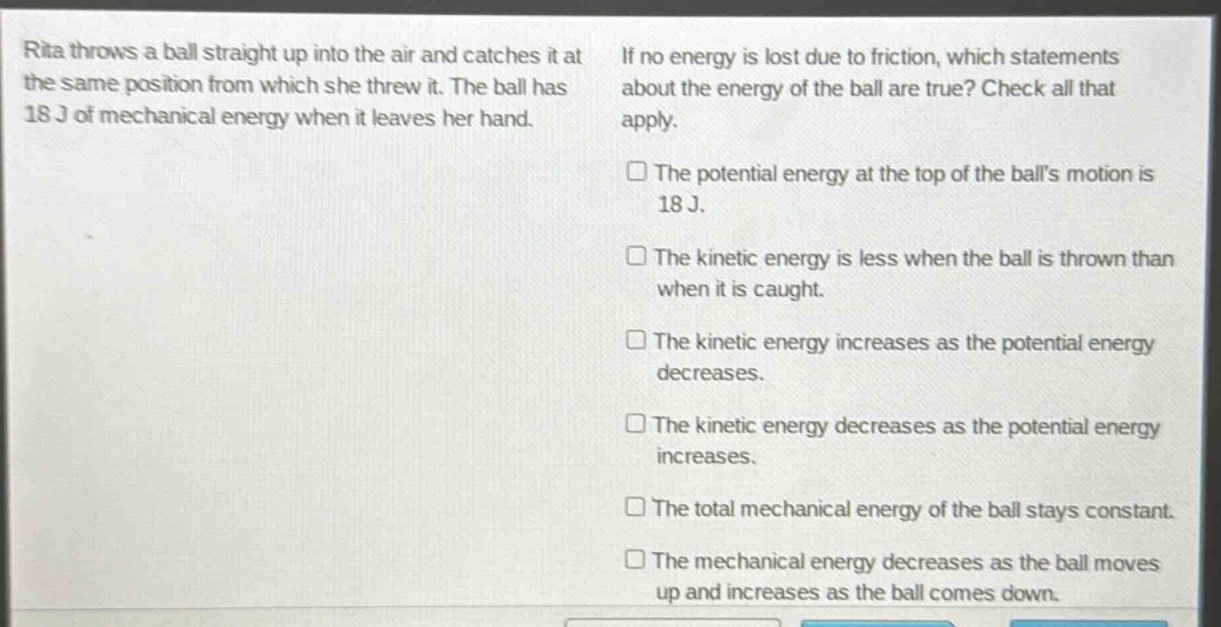
rita throws a ball straight up into the air and catches it at the same position from which she threw it. the ball has 18 j of mechanical energy when it leaves her hand. if no energy is lost due to friction, which statements about the energy of the ball are true? check all that apply. the potential energy at the top of the balls motion is 18 j. the kinetic energy is less when the ball is thrown than when it is caught. the kinetic energy increases as the potential energy decreases. the kinetic energy decreases as the potential energy increases. the total mechanical energy of the ball stays constant. the mechanical energy decreases as the ball moves up and increases as the ball comes down.
Answer
Explanation:
Step1: Understand mechanical - energy conservation
Mechanical energy (E = K+U), where (K) is kinetic energy and (U) is potential energy. When there is no friction, mechanical energy is conserved.
Step2: Analyze the top - most point
At the top of the ball's motion, the velocity (v = 0), so the kinetic energy (K=0). Since the initial mechanical energy (E = 18\ J) and (E) is conserved, the potential energy (U) at the top is (18\ J).
Step3: Analyze kinetic and potential energy changes
As the ball moves up, its height (h) increases. Using (U = mgh) (where (g) is the acceleration due to gravity and (m) is the mass of the ball), potential energy increases. Since (E=K + U) and (E) is constant, kinetic energy (K) decreases. As the ball comes down, (U) decreases and (K) increases.
Step4: Analyze total mechanical energy
Since there is no energy loss due to friction, the total mechanical energy (E) of the ball stays constant throughout the motion.
Answer:
The potential energy at the top of the ball's motion is 18 J.; The kinetic energy increases as the potential energy decreases.; The kinetic energy decreases as the potential energy increases.; The total mechanical energy of the ball stays constant.