a sample contains 16.75 g of the radioisotope u - 236 and 50.25 g of its daughter isotope, th - 232. how…
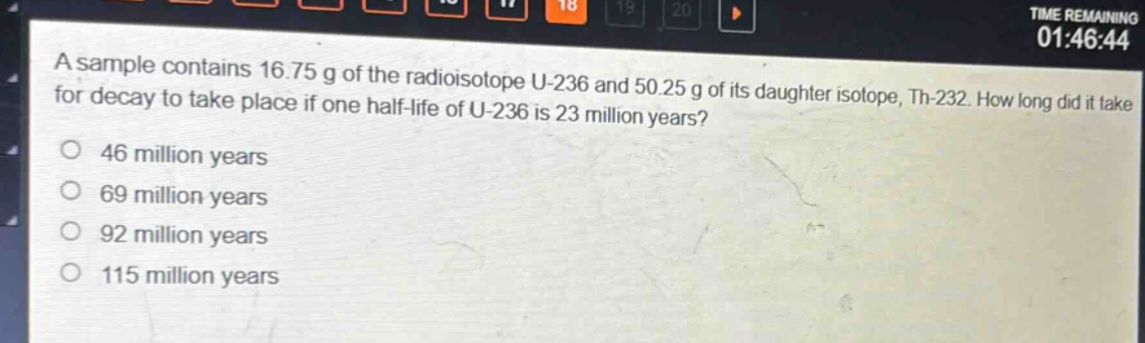
a sample contains 16.75 g of the radioisotope u - 236 and 50.25 g of its daughter isotope, th - 232. how long did it take for decay to take place if one half - life of u - 236 is 23 million years?\n46 million years\n69 million years\n92 million years\n115 million years
Answer
Explanation:
Step1: Calculate total mass
The total mass of the sample is the sum of the mass of U - 236 and Th - 232. So, $m_{total}=16.75 + 50.25=67$ g.
Step2: Determine the fraction of U - 236 remaining
The fraction of U - 236 remaining, $f=\frac{16.75}{67}=\frac{1}{4}$.
Step3: Relate fraction to half - lives
We know that the amount of a radioactive substance remaining after $n$ half - lives is given by $N = N_0(\frac{1}{2})^n$. Since $f=\frac{1}{4}=(\frac{1}{2})^2$, $n = 2$.
Step4: Calculate time elapsed
The time elapsed $t$ is the number of half - lives times the length of one half - life. Given that one half - life of U - 236 is 23 million years, $t=2\times23 = 46$ million years.
Answer:
46 million years