a sample contains 25% parent isotope and 75% daughter isotopes. if the half - life of the parent isotope is…
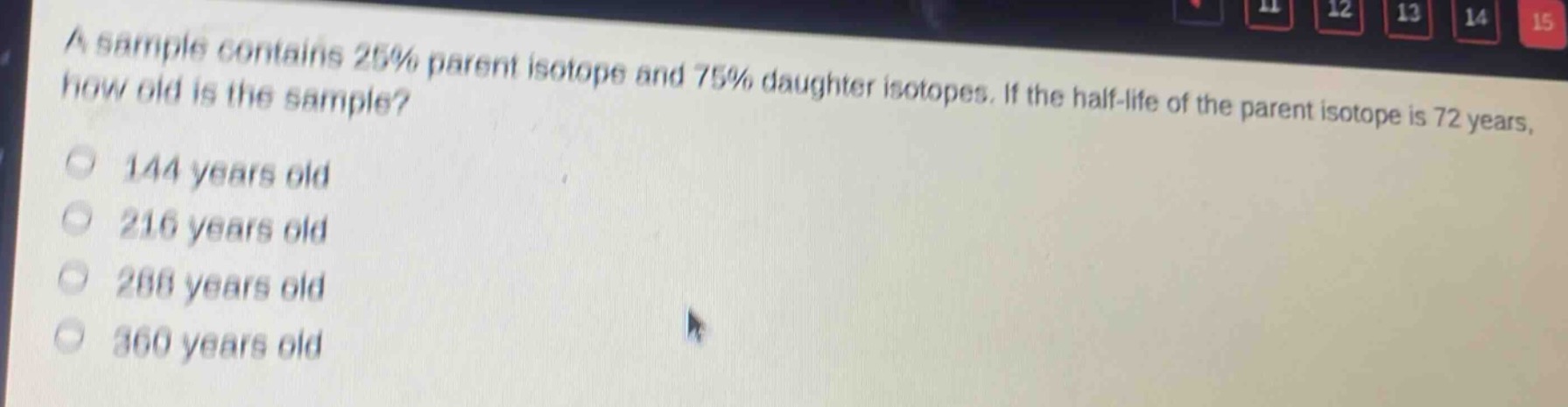
a sample contains 25% parent isotope and 75% daughter isotopes. if the half - life of the parent isotope is 72 years, how old is the sample?\n144 years old\n216 years old\n288 years old\n360 years old
Answer
Explanation:
Step1: Understand half - life concept
The amount of parent isotope remaining after (n) half - lives is given by (N = N_0\times(\frac{1}{2})^n), where (N) is the final amount of parent isotope, (N_0) is the initial amount of parent isotope. Here, if we assume the initial amount of parent isotope (N_0 = 100%), and the remaining amount (N=25%).
Step2: Set up the equation
We have (25 = 100\times(\frac{1}{2})^n). Divide both sides by 100: (\frac{25}{100}=(\frac{1}{2})^n), so (0.25 = (\frac{1}{2})^n). Since (0.25=\frac{1}{4}=(\frac{1}{2})^2), then (n = 2).
Step3: Calculate the age of the sample
The half - life of the parent isotope (t_{1/2}=72) years. The age of the sample (t=n\times t_{1/2}). Substitute (n = 2) and (t_{1/2}=72) years into the formula, we get (t=2\times72 = 144) years.
Answer:
144 years old