a sample contains 2.2 g of the radioisotope niobium - 91 and 15.4 g of its daughter isotope, zirconium - 91…
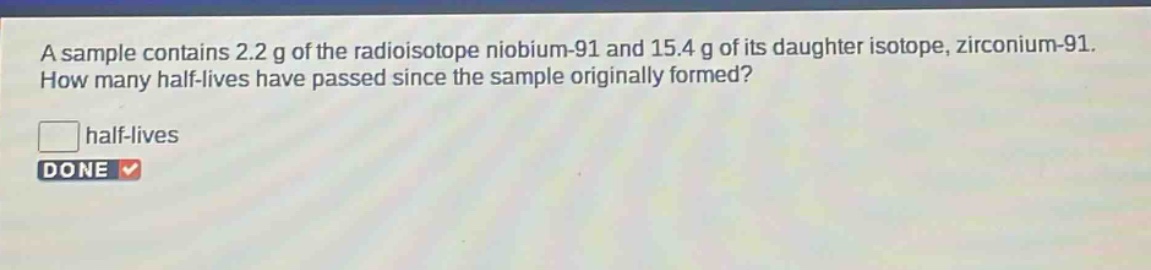
a sample contains 2.2 g of the radioisotope niobium - 91 and 15.4 g of its daughter isotope, zirconium - 91. how many half - lives have passed since the sample originally formed? half - lives done
Answer
Explanation:
Step1: Calculate the original amount of niobium - 91
The original amount of niobium - 91 is the sum of the remaining niobium - 91 and the amount that has decayed (which is now zirconium - 91). So, $m_0=2.2 + 15.4=17.6$ g.
Step2: Use the radioactive - decay formula
The formula for radioactive decay is $m = m_0(\frac{1}{2})^n$, where $m$ is the remaining amount of the radioactive isotope, $m_0$ is the original amount, $n$ is the number of half - lives. We know $m = 2.2$ g and $m_0 = 17.6$ g. Substitute these values into the formula: $2.2=17.6(\frac{1}{2})^n$.
Step3: Solve for $n$
First, divide both sides of the equation by 17.6: $\frac{2.2}{17.6}=(\frac{1}{2})^n$. Simplify $\frac{2.2}{17.6}=\frac{1}{8}$. So, $\frac{1}{8}=(\frac{1}{2})^n$. Since $\frac{1}{8}=\frac{1}{2^3}$, then $n = 3$.
Answer:
3