a sample of gas is enclosed in a container of fixed volume. identify which of the following statements are…
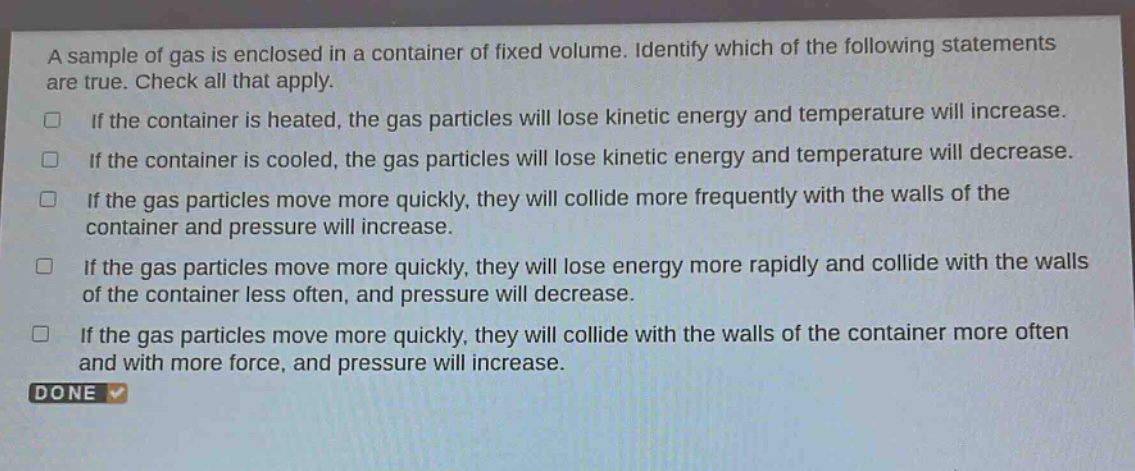
a sample of gas is enclosed in a container of fixed volume. identify which of the following statements are true. check all that apply.\nif the container is heated, the gas particles will lose kinetic energy and temperature will increase.\nif the container is cooled, the gas particles will lose kinetic energy and temperature will decrease.\nif the gas particles move more quickly, they will collide more frequently with the walls of the container and pressure will increase.\nif the gas particles move more quickly, they will lose energy more rapidly and collide with the walls of the container less often, and pressure will decrease.\nif the gas particles move more quickly, they will collide with the walls of the container more often and with more force, and pressure will increase.
Answer
Explanation:
Step1: Recall kinetic - theory of gases
The average kinetic energy of gas particles is directly proportional to the temperature of the gas. When a gas in a fixed - volume container is heated, the temperature increases and the kinetic energy of the gas particles increases, not decreases. So the statement "If the container is heated, the gas particles will lose kinetic energy and temperature will increase" is false.
Step2: Analyze cooling effect
When the container is cooled, the temperature of the gas decreases. Since the average kinetic energy of gas particles is proportional to the temperature, the gas particles will lose kinetic energy. So the statement "If the container is cooled, the gas particles will lose kinetic energy and temperature will decrease" is true.
Step3: Consider particle motion and pressure
The pressure of a gas in a container is due to the collisions of gas particles with the walls of the container. If the gas particles move more quickly, they have higher kinetic energy. They will collide with the walls of the container more frequently and with more force. According to the kinetic - theory of gases, this will result in an increase in pressure. So the statements "If the gas particles move more quickly, they will collide more frequently with the walls of the container and pressure will increase" and "If the gas particles move more quickly, they will collide with the walls of the container more often and with more force, and pressure will increase" are true. The statement "If the gas particles move more quickly, they will lose energy more rapidly and collide with the walls of the container less often, and pressure will decrease" is false.
Answer:
If the container is cooled, the gas particles will lose kinetic energy and temperature will decrease. If the gas particles move more quickly, they will collide more frequently with the walls of the container and pressure will increase. If the gas particles move more quickly, they will collide with the walls of the container more often and with more force, and pressure will increase.