a sample of oak has a density of 807 kilograms per cubic meter. the sample is in the shape of a cube, where…
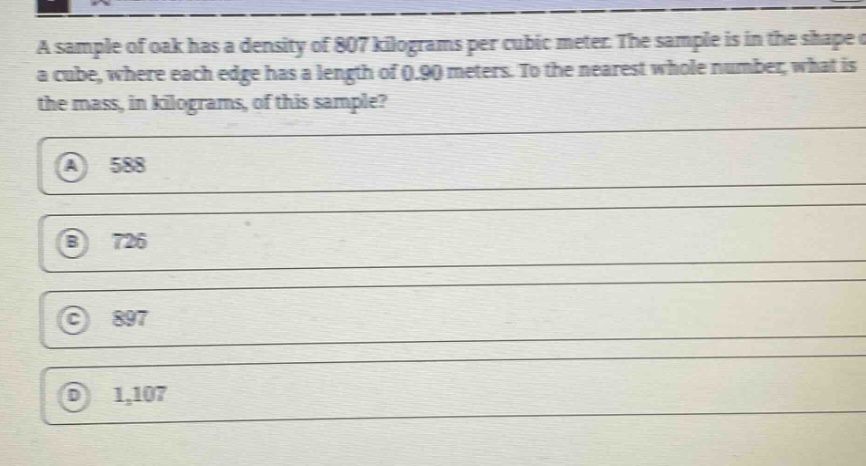
a sample of oak has a density of 807 kilograms per cubic meter. the sample is in the shape of a cube, where each edge has a length of 0.90 meters. to the nearest whole number, what is the mass, in kilograms, of this sample?\na 588\nb 726\nc 897\nd 1,107
Answer
Explanation:
Step1: Calculate volume of cube
The volume formula for a cube is $V = s^3$, where $s$ is the side - length. Given $s = 0.90$ m, so $V=(0.90)^3=0.90\times0.90\times0.90 = 0.729$ m³.
Step2: Calculate mass using density formula
The density formula is $\rho=\frac{m}{V}$, where $\rho$ is density, $m$ is mass, and $V$ is volume. Rearranging for $m$ gives $m=\rho V$. Given $\rho = 807$ kg/m³ and $V = 0.729$ m³, then $m=807\times0.729 = 807\times(0.7 + 0.02+0.009)=807\times0.7+807\times0.02 + 807\times0.009=564.9+16.14+7.263 = 588.303\approx588$ kg.
Answer:
A. 588