a sample of an unknown substance has a mass of 0.465 kg. if 3,000.0 j of heat is required to heat the…
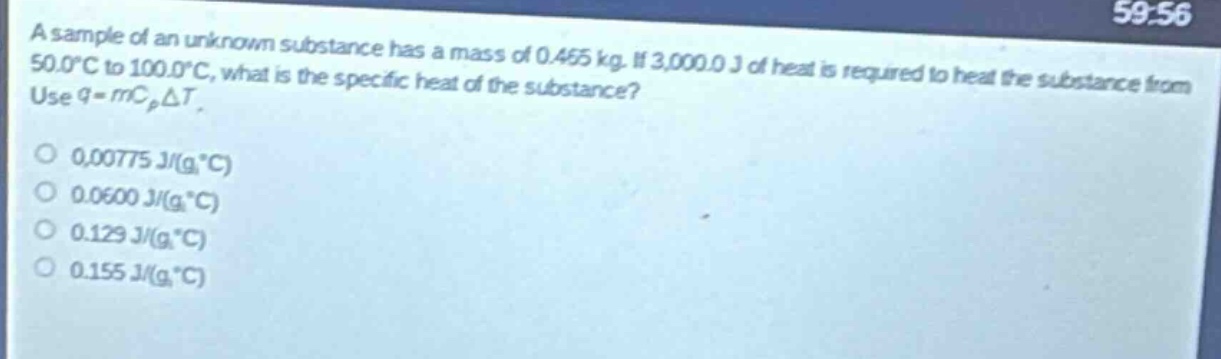
a sample of an unknown substance has a mass of 0.465 kg. if 3,000.0 j of heat is required to heat the substance from 50.0°c to 100.0°c, what is the specific heat of the substance? use q = mc_pδt.\n0.00775 j/(g·°c)\n0.0600 j/(g·°c)\n0.129 j/(g·°c)\n0.155 j/(g·°c)
Answer
Explanation:
Step1: Convert mass to grams
$m = 0.465\ kg\times1000 = 465\ g$
Step2: Calculate the temperature change
$\Delta T=100.0^{\circ}C - 50.0^{\circ}C=50.0^{\circ}C$
Step3: Rearrange the heat - formula for specific heat
$C_p=\frac{q}{m\Delta T}$
Step4: Substitute values
$C_p=\frac{3000.0\ J}{465\ g\times50.0^{\circ}C}=\frac{3000.0}{23250}\ J/(g^{\circ}C)\approx0.129\ J/(g^{\circ}C)$
Answer:
C. $0.129\ J/(g^{\circ}C)$