sarah kicked a ball in the air. the function f models the height of the ball (in meters) as a function of…
sarah kicked a ball in the air. the function f models the height of the ball (in meters) as a function of time (in seconds) after sarah kicked it. which of these statements are true? choose all answers that apply: a the ball moved upwards for about 3.5 s. b the ball started moving upwards after about 1.75 s. c the ball hit the ground after about 3.5 s. d the ball hit the ground after about 1.75 s.
Answer
Explanation:
Step1: Analyze the graph
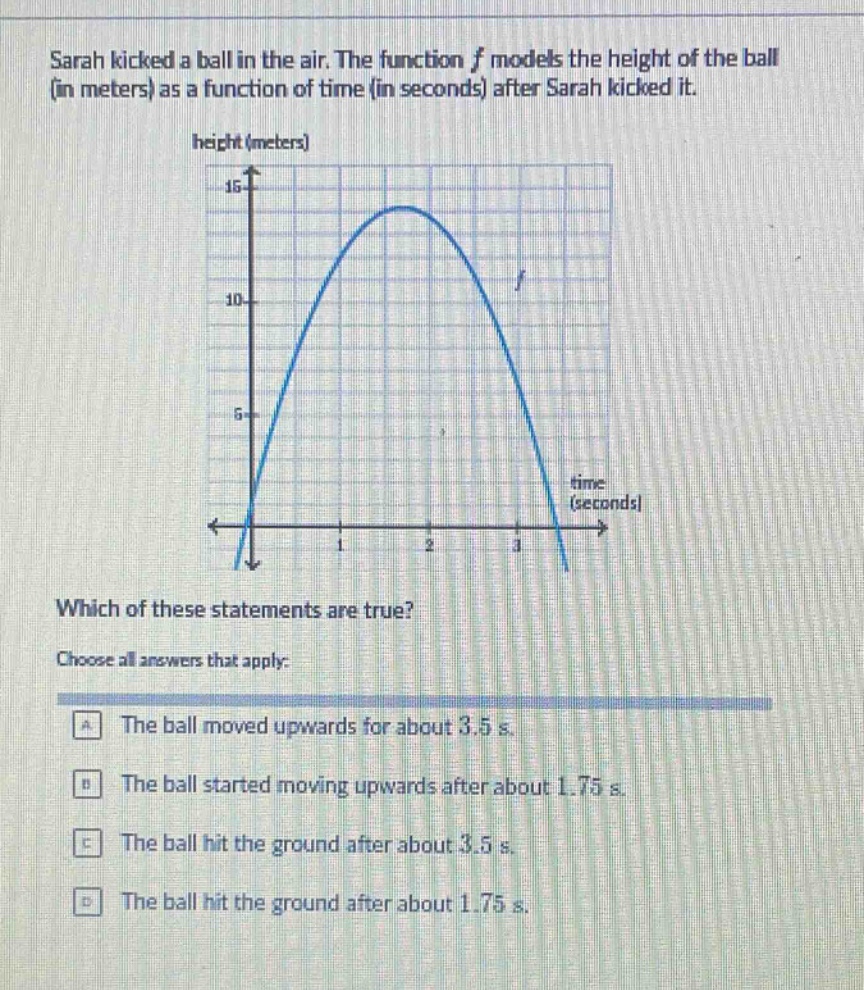
The graph shows the height of the ball as a function of time. The ball starts at the ground (height = 0), moves upwards, reaches a maximum - height, and then falls back to the ground (height = 0 again).
Step2: Determine when the ball hits the ground
The ball hits the ground when the height (y = f(t)=0). Looking at the graph, the ball hits the ground at approximately (t = 3.5) seconds. The ball moves upwards from (t = 0) until it reaches its maximum - height (around (t = 1.75) s) and then moves downwards.
Step3: Evaluate each option
- Option A: The ball moves upwards until it reaches its maximum height. The maximum height is reached around (t = 1.75) s, not (3.5) s. So, option A is false.
- Option B: The ball starts moving upwards at (t = 0) s, not after (1.75) s. So, option B is false.
- Option C: The ball hits the ground when the height is 0 again. From the graph, this occurs at approximately (t = 3.5) s. So, option C is true.
- Option D: The ball does not hit the ground at (t = 1.75) s. At (t = 1.75) s, it reaches its maximum height. So, option D is false.
Answer:
C. The ball hit the ground after about 3.5 s.