sayid recorded the temperatures of four substances in a chart. temperatures of four substances substance…
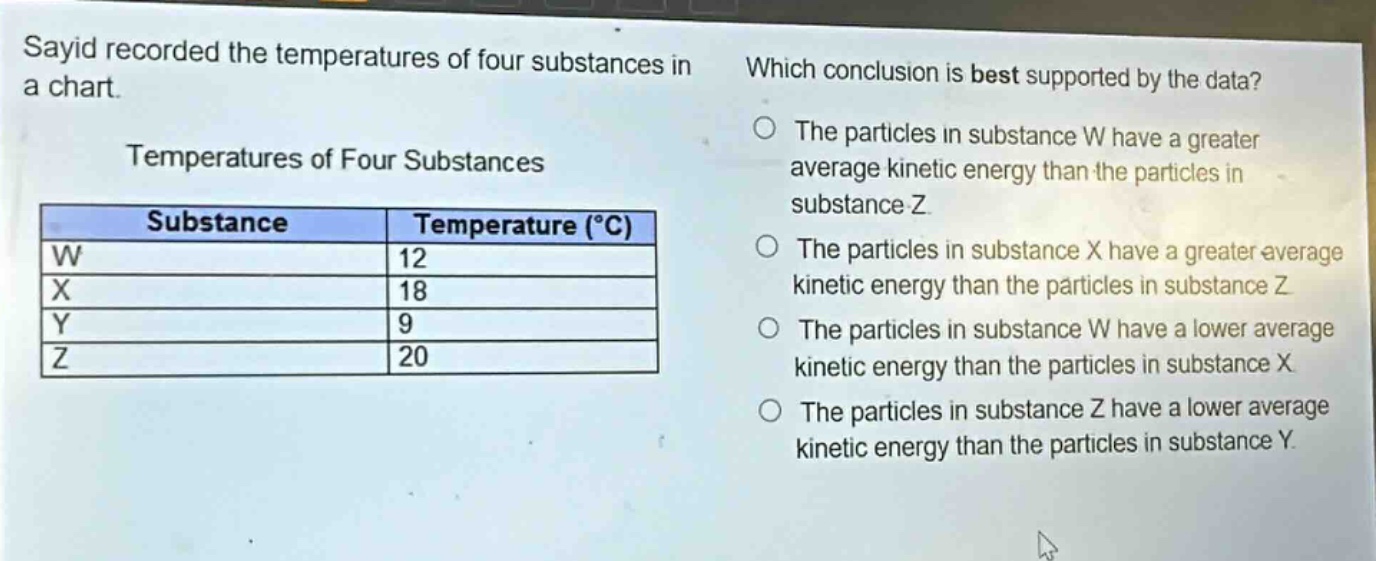
sayid recorded the temperatures of four substances in a chart. temperatures of four substances substance temperature (°c) w 12 x 18 y 9 z 20 which conclusion is best supported by the data? the particles in substance w have a greater average kinetic energy than the particles in substance z. the particles in substance x have a greater average kinetic energy than the particles in substance z. the particles in substance w have a lower average kinetic energy than the particles in substance x. the particles in substance z have a lower average kinetic energy than the particles in substance y.
Answer
Brief Explanations:
The average kinetic energy of particles is directly proportional to temperature. Higher - temperature substances have particles with higher average kinetic energy. Comparing the temperatures of substances W (12°C), X (18°C), Y (9°C), and Z (20°C), we can analyze each option.
Answer:
The particles in substance W have a lower average kinetic energy than the particles in substance X because the temperature of W (12°C) is lower than that of X (18°C). So the correct conclusion is: The particles in substance W have a lower average kinetic energy than the particles in substance X.