a scientist discovers a spherical object in the solar system with a mass of 1.1×10²⁵ grams and a volume of…
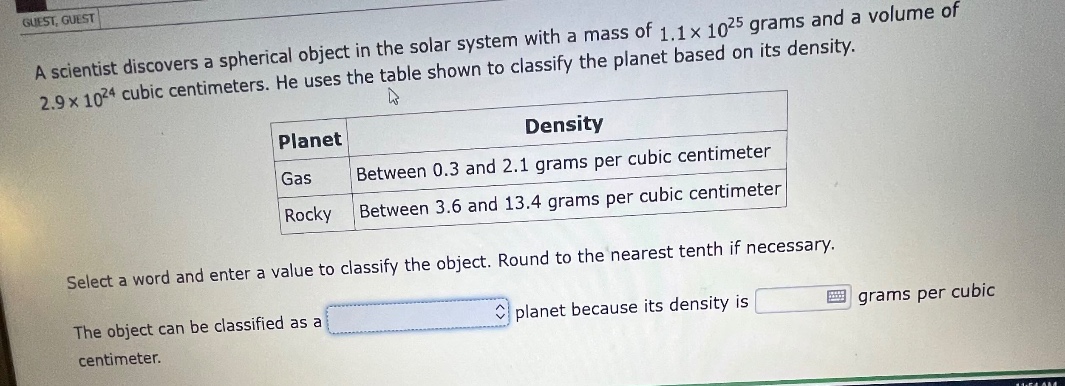
a scientist discovers a spherical object in the solar system with a mass of 1.1×10²⁵ grams and a volume of 2.9×10²⁴ cubic centimeters. he uses the table shown to classify the planet based on its density.\n| planet | density |\n| ---- | ---- |\n| gas | between 0.3 and 2.1 grams per cubic centimeter |\n| rocky | between 3.6 and 13.4 grams per cubic centimeter |\nselect a word and enter a value to classify the object. round to the nearest tenth if necessary.\nthe object can be classified as a planet because its density is grams per cubic centimeter.
Answer
Explanation:
Step1: Recall density formula
Density $\rho=\frac{m}{V}$, where $m$ is mass and $V$ is volume.
Step2: Substitute given values
$m = 1.1\times10^{25}$ grams and $V=2.9\times 10^{24}$ cubic - centimeters. So, $\rho=\frac{1.1\times 10^{25}}{2.9\times 10^{24}}$.
Step3: Simplify the expression
Using the rule of exponents $\frac{a^m}{a^n}=a^{m - n}$, we have $\rho=\frac{1.1}{2.9}\times10^{25-24}=\frac{1.1}{2.9}\times10\approx3.8$ grams per cubic - centimeter.
Step4: Classify the object
Since $3.6\leqslant3.8\leqslant13.4$, the object is a rocky planet.
Answer:
The object can be classified as a rocky planet because its density is $3.8$ grams per cubic centimeter.