a scientist notices that a lump of niobium is warm to the touch and wonders if nuclear reactions are taking…
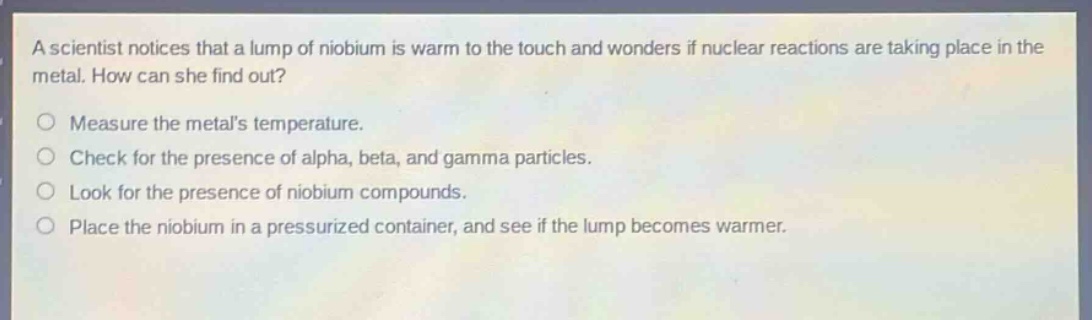
a scientist notices that a lump of niobium is warm to the touch and wonders if nuclear reactions are taking place in the metal. how can she find out? measure the metals temperature. check for the presence of alpha, beta, and gamma particles. look for the presence of niobium compounds. place the niobium in a pressurized container, and see if the lump becomes warmer.
Answer
Explanation:
Step1: Understand nuclear reactions
Nuclear reactions emit alpha, beta, or gamma - radiation.
Step2: Analyze each option
- Measuring temperature only tells about heat level, not nuclear reactions.
- Looking for niobium compounds is unrelated to nuclear reactions in pure niobium.
- Placing in a pressurized container doesn't directly indicate nuclear reactions.
- Checking for alpha, beta, and gamma particles can confirm if nuclear reactions are occurring as these are by - products of nuclear reactions.
Answer:
Check for the presence of alpha, beta, and gamma particles.