scientists launch a rocket, and they monitor its acceleration and the force exerted by its engines. as the…
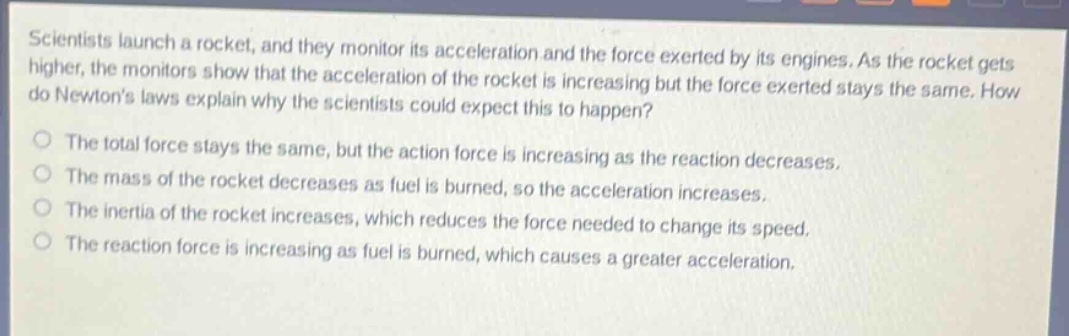
scientists launch a rocket, and they monitor its acceleration and the force exerted by its engines. as the rocket gets higher, the monitors show that the acceleration of the rocket is increasing but the force exerted stays the same. how do newtons laws explain why the scientists could expect this to happen?\nthe total force stays the same, but the action force is increasing as the reaction decreases.\nthe mass of the rocket decreases as fuel is burned, so the acceleration increases.\nthe inertia of the rocket increases, which reduces the force needed to change its speed.\nthe reaction force is increasing as fuel is burned, which causes a greater acceleration.
Answer
Brief Explanations:
According to Newton's second - law $F = ma$ (where $F$ is force, $m$ is mass, and $a$ is acceleration). When the force $F$ exerted by the engines stays the same, if the mass $m$ of the rocket decreases (as fuel is burned), the acceleration $a$ must increase.
Answer:
The mass of the rocket decreases as fuel is burned, so the acceleration increases.