section 20.2 review\n1. how are electric circuits and systems for carrying water in buildings similar?\n2…
section 20.2 review\n1. how are electric circuits and systems for carrying water in buildings similar?\n2. give one example of a circuit found in nature and one example of a circuit created by people.\n3. draw a circuit diagram for the circuit in figure 20.9.\n4. what is the difference between an open circuit and a closed circuit?\n5. what does a resistor do in a circuit? give an example.\n6. use the circuit diagram below to answer the following questions.\na. how many bulbs are there in this circuit?\nb. how many batteries?\nc. how many resistors?\nd. how many switches?\ne. is this circuit open or closed? justify your answer.\n7. when you turn “on” a light switch in a room, does this open or close the circuit? explain.
Answer
Explanation:
Step1: Count bulbs
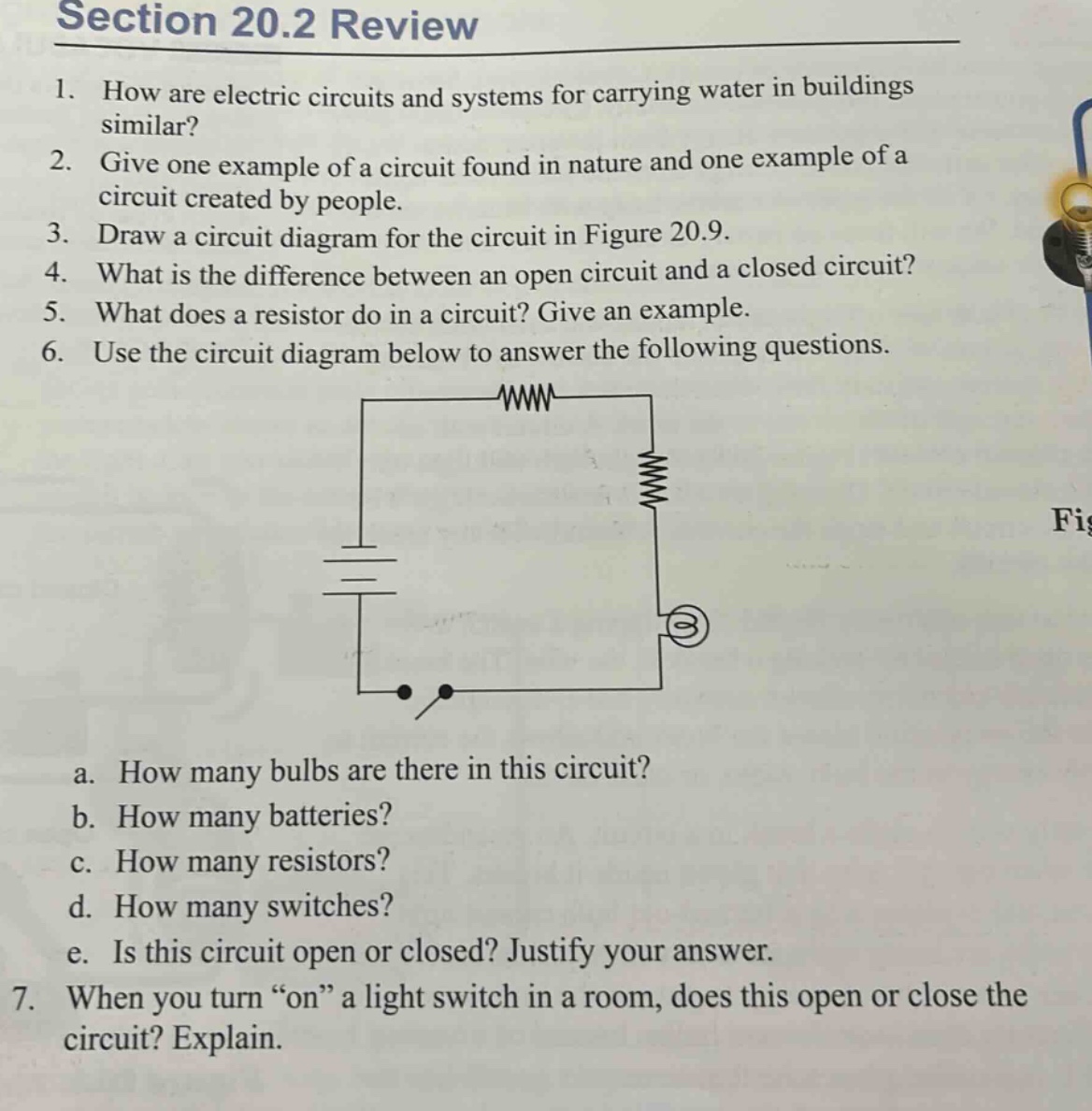
Count the bulb - shaped symbols in the circuit diagram. There is 1 bulb.
Step2: Count batteries
Count the parallel - line symbols representing batteries. There is 1 battery.
Step3: Count resistors
Count the zig - zag symbols representing resistors. There are 2 resistors.
Step4: Count switches
Count the switch symbols. There is 1 switch.
Step5: Determine circuit state
The switch is open as the two contact points are not connected, so the circuit is open.
Step6: Analyze light - switch action
When you turn “on” a light switch in a room, it closes the circuit. This allows electric current to flow through the circuit, powering the light bulb.
Answer:
a. 1 bulb b. 1 battery c. 2 resistors d. 1 switch e. Open, because the switch is not connected. 7. Closes the circuit. Turning on the switch connects the circuit, allowing current to flow.