select the correct answer.\na ball is released from a hot air balloon moving downward with a velocity of…
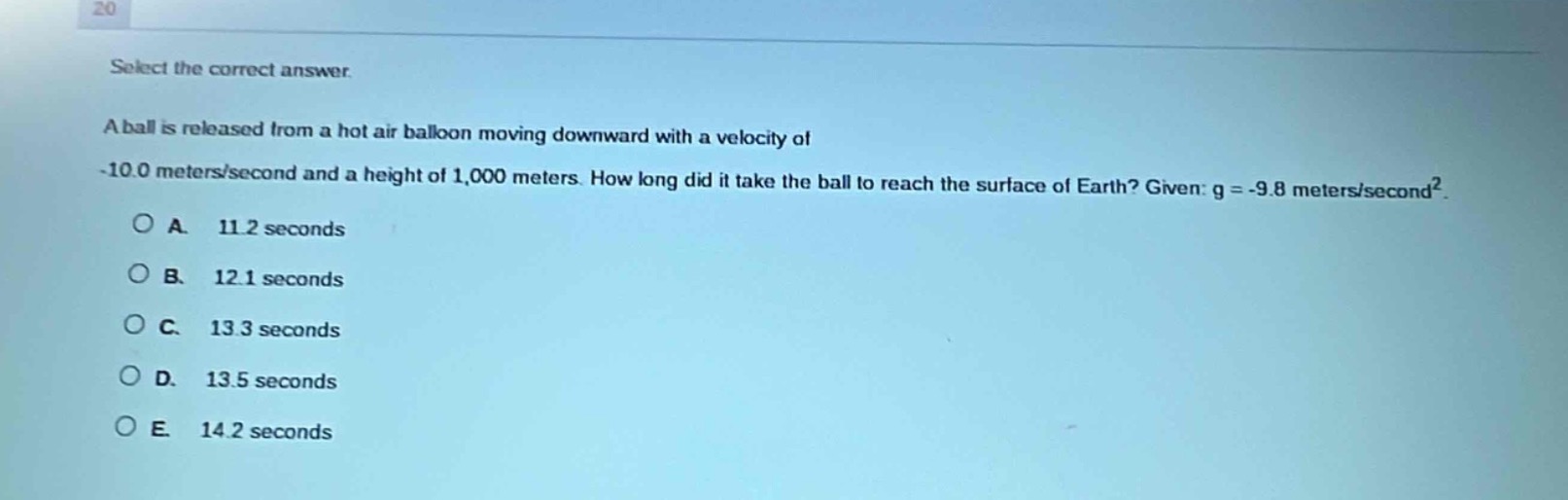
select the correct answer.\na ball is released from a hot air balloon moving downward with a velocity of -10.0 meters/second and a height of 1,000 meters. how long did it take the ball to reach the surface of earth? given: g = -9.8 meters/second².\na. 11.2 seconds\nb. 12.1 seconds\nc. 13.3 seconds\nd. 13.5 seconds\ne. 14.2 seconds
Answer
Explanation:
Step1: Identify the kinematic - equation
We use the equation $h = v_0t+\frac{1}{2}gt^{2}$, where $h = 1000$ m, $v_0=- 10$ m/s, and $g=-9.8$ m/s². Substituting these values, we get $1000=-10t-\frac{1}{2}\times9.8t^{2}$. Rearranging gives $4.9t^{2}+10t - 1000 = 0$.
Step2: Use the quadratic - formula
The quadratic formula for $ax^{2}+bx + c = 0$ is $t=\frac{-b\pm\sqrt{b^{2}-4ac}}{2a}$. Here, $a = 4.9$, $b = 10$, and $c=-1000$. First, calculate the discriminant $\Delta=b^{2}-4ac=(10)^{2}-4\times4.9\times(-1000)=100 + 19600=19700$.
Step3: Calculate the value of t
$t=\frac{-10\pm\sqrt{19700}}{2\times4.9}=\frac{-10\pm140.36}{9.8}$. We take the positive root since time cannot be negative. $t=\frac{-10 + 140.36}{9.8}=\frac{130.36}{9.8}\approx13.3$ s.
Answer:
C. 13.3 seconds