select the correct answer.\na baseball with a mass of 0.145 kilograms collides with a bat at a velocity of…
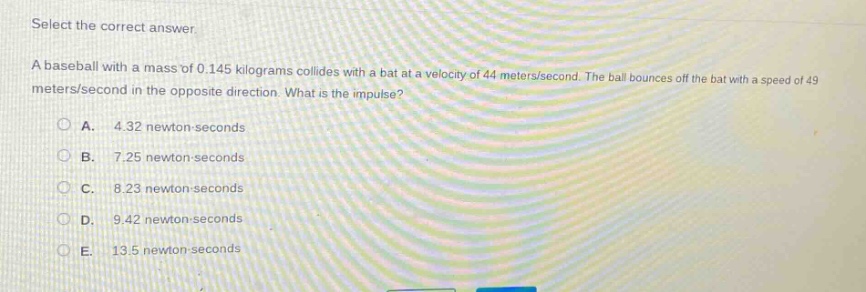
select the correct answer.\na baseball with a mass of 0.145 kilograms collides with a bat at a velocity of 44 meters/second. the ball bounces off the bat with a speed of 49 meters/second in the opposite direction. what is the impulse?\na. 4.32 newton - seconds\nb. 7.25 newton - seconds\nc. 8.23 newton - seconds\nd. 9.42 newton - seconds\ne. 13.5 newton - seconds
Answer
Explanation:
Step1: Define the impulse - momentum theorem
Impulse $J$ is equal to the change in momentum $\Delta p$. The formula for momentum is $p = mv$. Let the initial velocity $v_1=44\ m/s$ and the final velocity $v_2 = - 49\ m/s$ (negative because it's in the opposite direction), and the mass $m = 0.145\ kg$.
Step2: Calculate the initial and final momentum
The initial momentum $p_1=mv_1=0.145\times44 = 6.38\ kg\cdot m/s$. The final momentum $p_2=mv_2=0.145\times(-49)=-7.105\ kg\cdot m/s$.
Step3: Calculate the change in momentum (impulse)
$\Delta p=p_2 - p_1=-7.105 - 6.38=-13.485\ kg\cdot m/s$. The magnitude of the impulse $J=\vert\Delta p\vert = 13.485\approx13.5\ N\cdot s$.
Answer:
E. 13.5 newton - seconds