select the correct answer.\nthe distance between a sound source and a listener is decreased to half the…
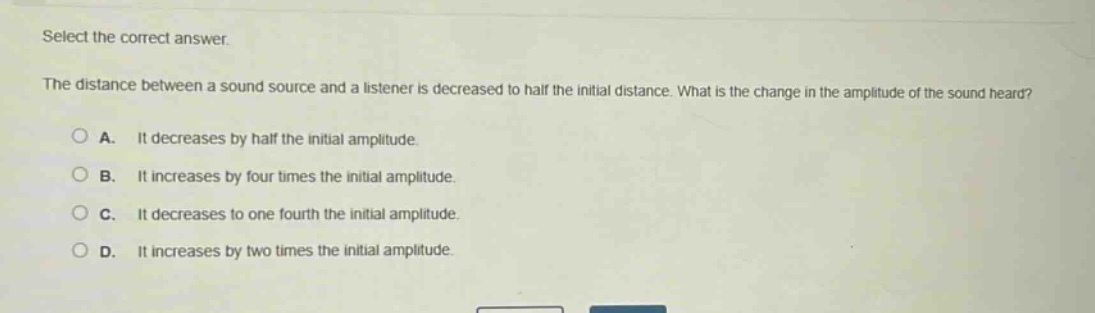
select the correct answer.\nthe distance between a sound source and a listener is decreased to half the initial distance. what is the change in the amplitude of the sound heard?\na. it decreases by half the initial amplitude.\nb. it increases by four times the initial amplitude.\nc. it decreases to one - fourth the initial amplitude.\nd. it increases by two times the initial amplitude.
Answer
Explanation:
Step1: Recall the relationship between amplitude and distance
The intensity of a sound wave is inversely proportional to the square of the distance from the source ($I\propto\frac{1}{r^{2}}$), and the amplitude of a sound - wave is proportional to the square - root of the intensity ($A\propto\sqrt{I}$). So, $A\propto\frac{1}{r}$.
Step2: Analyze the change in amplitude with distance change
Let the initial distance be $r_1$ and the final distance be $r_2$. Given $r_2=\frac{1}{2}r_1$. Since $A\propto\frac{1}{r}$, we can write $\frac{A_2}{A_1}=\frac{r_1}{r_2}$. Substitute $r_2 = \frac{1}{2}r_1$ into the above formula: $\frac{A_2}{A_1}=\frac{r_1}{\frac{1}{2}r_1}=2$. This means $A_2 = 2A_1$, that is, the amplitude increases by two times the initial amplitude.
Answer:
D. It increases by two times the initial amplitude.