select the correct answer from the drop - down menu. whats the kinetic energy of the roller coaster at the…
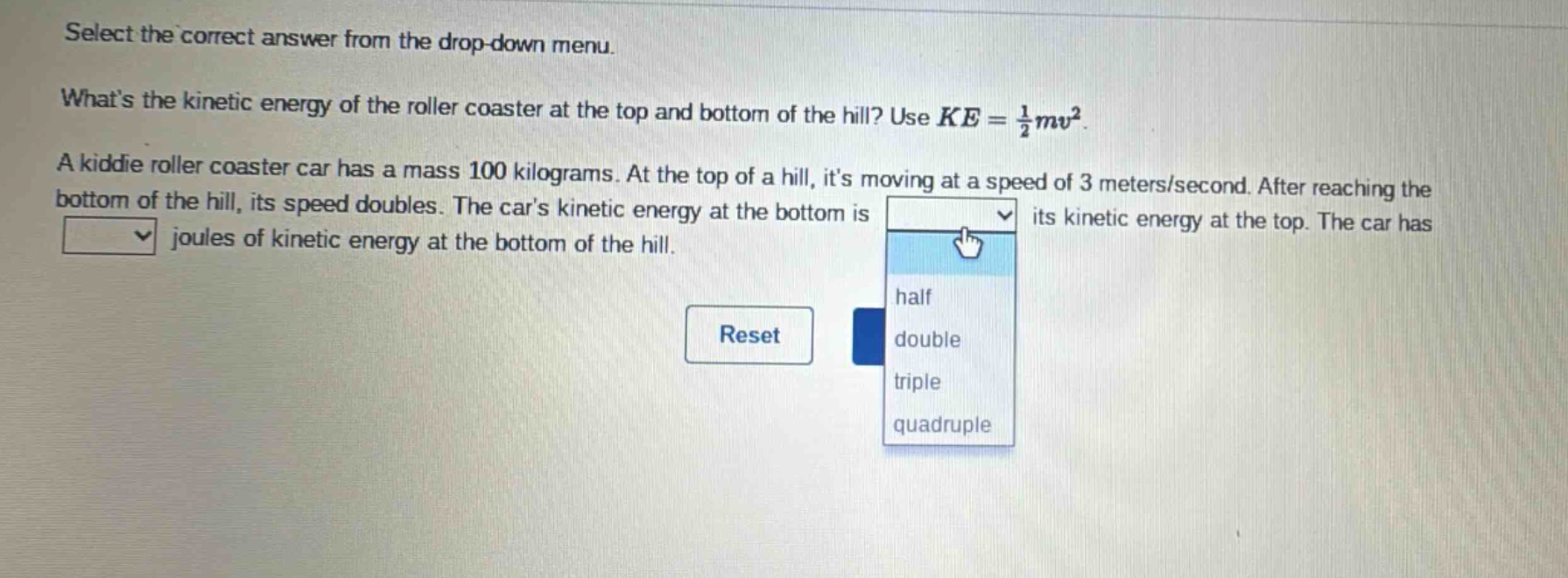
select the correct answer from the drop - down menu. whats the kinetic energy of the roller coaster at the top and bottom of the hill? use $ke=\frac{1}{2}mv^{2}$. a kiddie roller coaster car has a mass 100 kilograms. at the top of a hill, its moving at a speed of 3 meters/second. after reaching the bottom of the hill, its speed doubles. the cars kinetic energy at the bottom is its kinetic energy at the top. the car has joules of kinetic energy at the bottom of the hill.
Answer
Answer:
quadruple; 1800
Explanation:
Step1: Calculate KE at top
$KE_{top}=\frac{1}{2}mv_{top}^2$, where $m = 100$ kg and $v_{top}=3$ m/s. So $KE_{top}=\frac{1}{2}\times100\times3^2=\frac{1}{2}\times100\times9 = 450$ J.
Step2: Find speed at bottom
$v_{bottom}=2v_{top}$, since $v_{top}=3$ m/s, then $v_{bottom}=2\times3 = 6$ m/s.
Step3: Calculate KE at bottom
$KE_{bottom}=\frac{1}{2}mv_{bottom}^2$, with $m = 100$ kg and $v_{bottom}=6$ m/s. So $KE_{bottom}=\frac{1}{2}\times100\times6^2=\frac{1}{2}\times100\times36=1800$ J.
Step4: Compare KE values
$\frac{KE_{bottom}}{KE_{top}}=\frac{1800}{450}=4$. So the kinetic - energy at the bottom is quadruple the kinetic - energy at the top.