select the correct answer. what happens to the amplitude of the resultant wave when two sound waves with…
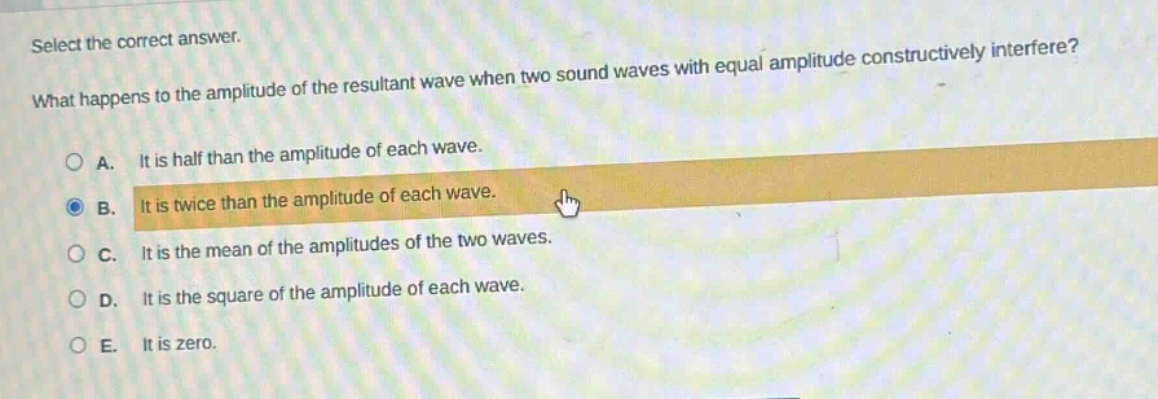
select the correct answer. what happens to the amplitude of the resultant wave when two sound waves with equal amplitude constructively interfere? a. it is half than the amplitude of each wave. b. it is twice than the amplitude of each wave. c. it is the mean of the amplitudes of the two waves. d. it is the square of the amplitude of each wave. e. it is zero.
Answer
Explanation:
Step1: Understand constructive interference
In constructive interference of two waves with equal amplitude $A_1 = A_2=A$, the amplitudes add up.
Step2: Calculate resultant amplitude
The resultant amplitude $A_R=A_1 + A_2$. Since $A_1 = A_2 = A$, then $A_R=A + A=2A$.
Answer:
B. It is twice than the amplitude of each wave.