select the correct answer.\nobject a has of mass 7.20 kilograms, and object b has a mass of 5.75 kilograms…
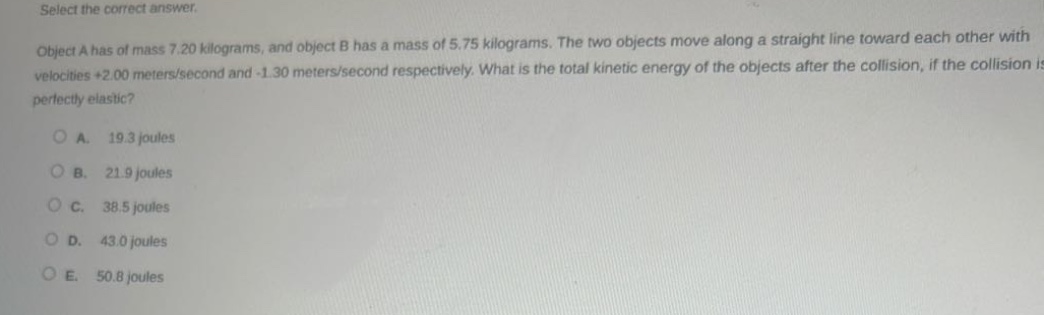
select the correct answer.\nobject a has of mass 7.20 kilograms, and object b has a mass of 5.75 kilograms. the two objects move along a straight line toward each other with velocities +2.00 meters/second and -1.30 meters/second respectively. what is the total kinetic energy of the objects after the collision, if the collision is perfectly elastic?\na. 19.3 joules\nb. 21.9 joules\nc. 38.5 joules\nd. 43.0 joules\ne. 50.8 joules
Answer
Explanation:
Step1: Recall kinetic - energy formula
The formula for kinetic energy is $K = \frac{1}{2}mv^{2}$, where $m$ is the mass and $v$ is the velocity.
Step2: Calculate kinetic energy of object A
For object A with $m_A=7.20\ kg$ and $v_A = 2.00\ m/s$, $K_A=\frac{1}{2}m_Av_A^{2}=\frac{1}{2}\times7.20\times(2.00)^{2}= \frac{1}{2}\times7.20\times4.00 = 14.4\ J$.
Step3: Calculate kinetic energy of object B
For object B with $m_B = 5.75\ kg$ and $v_B=- 1.30\ m/s$, $K_B=\frac{1}{2}m_Bv_B^{2}=\frac{1}{2}\times5.75\times(-1.30)^{2}=\frac{1}{2}\times5.75\times1.69 = 4.84375\ J$.
Step4: Calculate total kinetic energy
In a perfectly elastic collision, total kinetic energy is conserved. So $K_{total}=K_A + K_B=14.4+4.84375 = 19.24375\approx19.3\ J$.
Answer:
A. 19.3 joules