select the correct answer.\nobject a with a mass of 1.5 kilograms is moving with a velocity of +11.2…
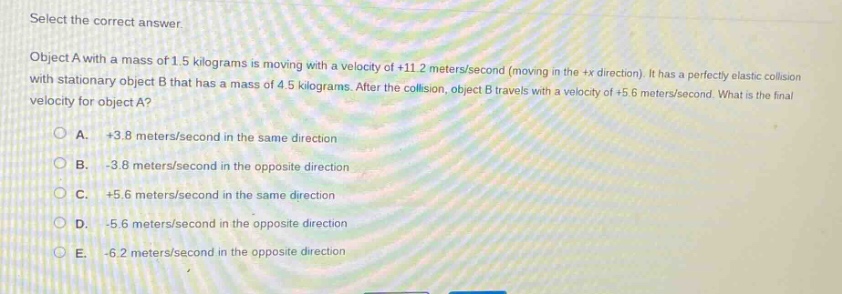
select the correct answer.\nobject a with a mass of 1.5 kilograms is moving with a velocity of +11.2 meters/second (moving in the +x direction). it has a perfectly elastic collision with stationary object b that has a mass of 4.5 kilograms. after the collision, object b travels with a velocity of +5.6 meters/second. what is the final velocity for object a?\na. +3.8 meters/second in the same direction\nb. -3.8 meters/second in the opposite direction\nc. +5.6 meters/second in the same direction\nd. -5.6 meters/second in the opposite direction\ne. -6.2 meters/second in the opposite direction
Answer
Explanation:
Step1: Apply conservation of momentum
The formula for conservation of momentum is $m_1u_1 + m_2u_2=m_1v_1 + m_2v_2$. Here, $m_1 = 1.5$ kg, $u_1=11.2$ m/s, $m_2 = 4.5$ kg, $u_2 = 0$ m/s, and $v_2=5.6$ m/s. Substitute the values: $1.5\times11.2+4.5\times0 = 1.5v_1+4.5\times5.6$.
Step2: Simplify the left - hand side
$1.5\times11.2=16.8$, so the equation becomes $16.8=1.5v_1 + 25.2$.
Step3: Solve for $v_1$
First, subtract 25.2 from both sides: $1.5v_1=16.8 - 25.2=- 8.4$. Then divide both sides by 1.5: $v_1=\frac{-8.4}{1.5}=- 5.6$ m/s.
Answer:
D. -5.6 meters/second in the opposite direction