select the correct answer.\nprofessor whitney has a sample of lead and a sample of iron. the samples have…
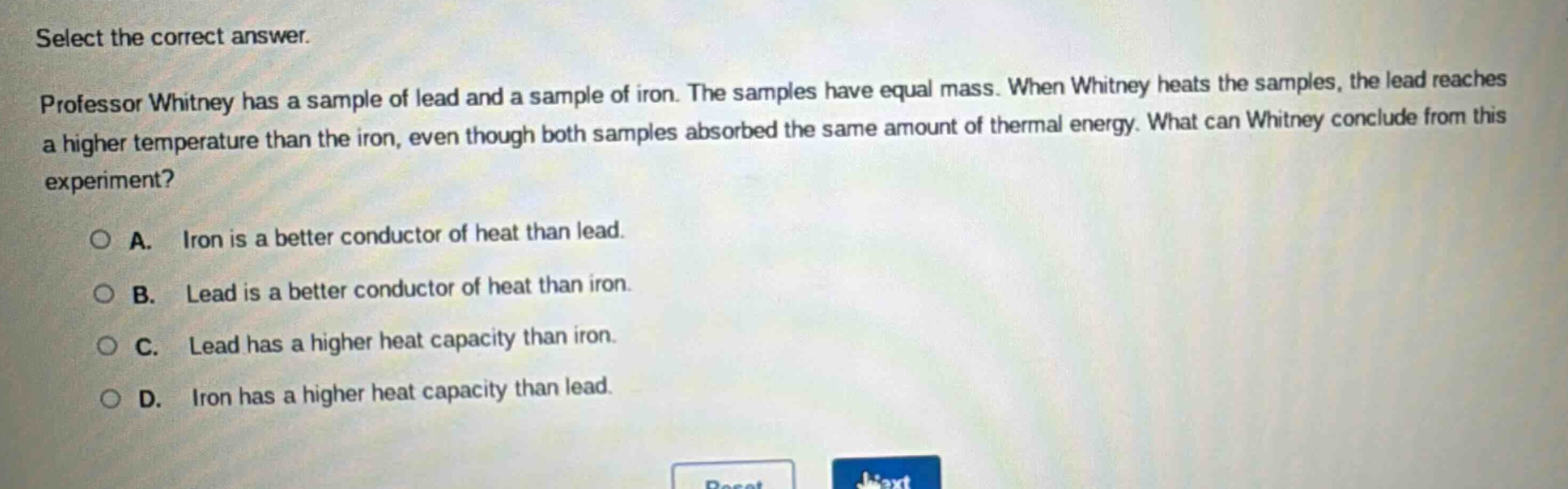
select the correct answer.\nprofessor whitney has a sample of lead and a sample of iron. the samples have equal mass. when whitney heats the samples, the lead reaches a higher temperature than the iron, even though both samples absorbed the same amount of thermal energy. what can whitney conclude from this experiment?\na. iron is a better conductor of heat than lead.\nb. lead is a better conductor of heat than iron.\nc. lead has a higher heat capacity than iron.\nd. iron has a higher heat capacity than lead.
Answer
Explanation:
Step1: Recall the heat - capacity formula
The formula for heat transfer is (Q = mc\Delta T), where (Q) is the heat absorbed, (m) is the mass, (c) is the specific heat capacity, and (\Delta T) is the change in temperature. Given that (m_{lead}=m_{iron}) (equal mass) and (Q_{lead} = Q_{iron}) (same heat absorbed).
Step2: Analyze the relationship between (c) and (\Delta T)
From (Q = mc\Delta T), we can solve for (c=\frac{Q}{m\Delta T}). Since (Q) and (m) are the same for both samples, (c\propto\frac{1}{\Delta T}). The sample with a higher temperature change ((\Delta T)) has a lower specific heat capacity. Lead has a higher temperature ((\Delta T_{lead}>\Delta T_{iron})), so (c_{lead}<c_{iron})
Answer:
D. Iron has a higher heat capacity than lead.