select the correct answer.\na sample taken from a layer of mica in a canyon has 2.10 grams of potassium…
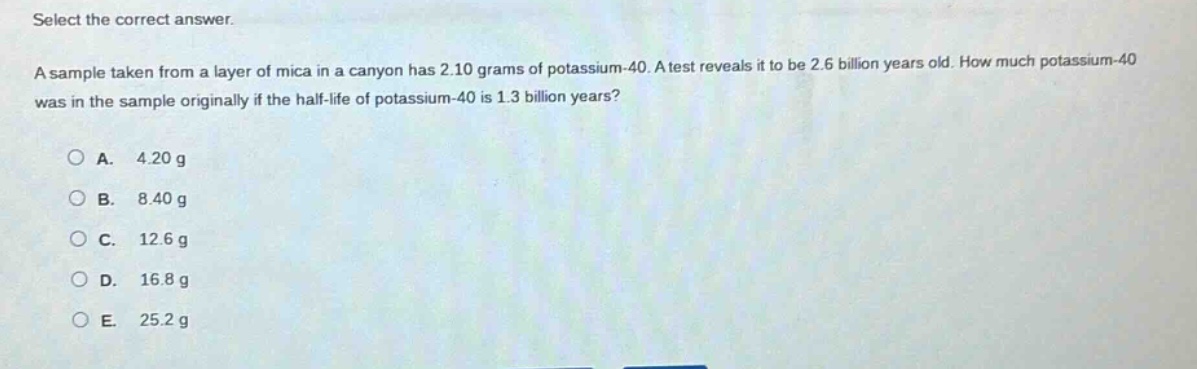
select the correct answer.\na sample taken from a layer of mica in a canyon has 2.10 grams of potassium - 40. a test reveals it to be 2.6 billion years old. how much potassium - 40 was in the sample originally if the half - life of potassium - 40 is 1.3 billion years?\n\na. 4.20 g\nb. 8.40 g\nc. 12.6 g\nd. 16.8 g\ne. 25.2 g
Answer
Explanation:
Step1: Calculate number of half - lives
The age of the sample is 2.6 billion years and the half - life of potassium - 40 is 1.3 billion years. The number of half - lives $n=\frac{2.6}{1.3}=2$.
Step2: Use the radioactive decay formula
The formula for radioactive decay is $N = N_0(\frac{1}{2})^n$, where $N$ is the current amount, $N_0$ is the original amount, and $n$ is the number of half - lives. We know $N = 2.10$ g and $n = 2$. Rearranging the formula for $N_0$ gives $N_0=N\times2^n$. Substitute $N = 2.10$ g and $n = 2$ into the formula: $N_0=2.10\times2^2$. $N_0=2.10\times4 = 8.40$ g.
Answer:
B. 8.40 g