select the correct answer.\na scientist has a sample of the radioactive isotope bismuth - 212. the isotope…
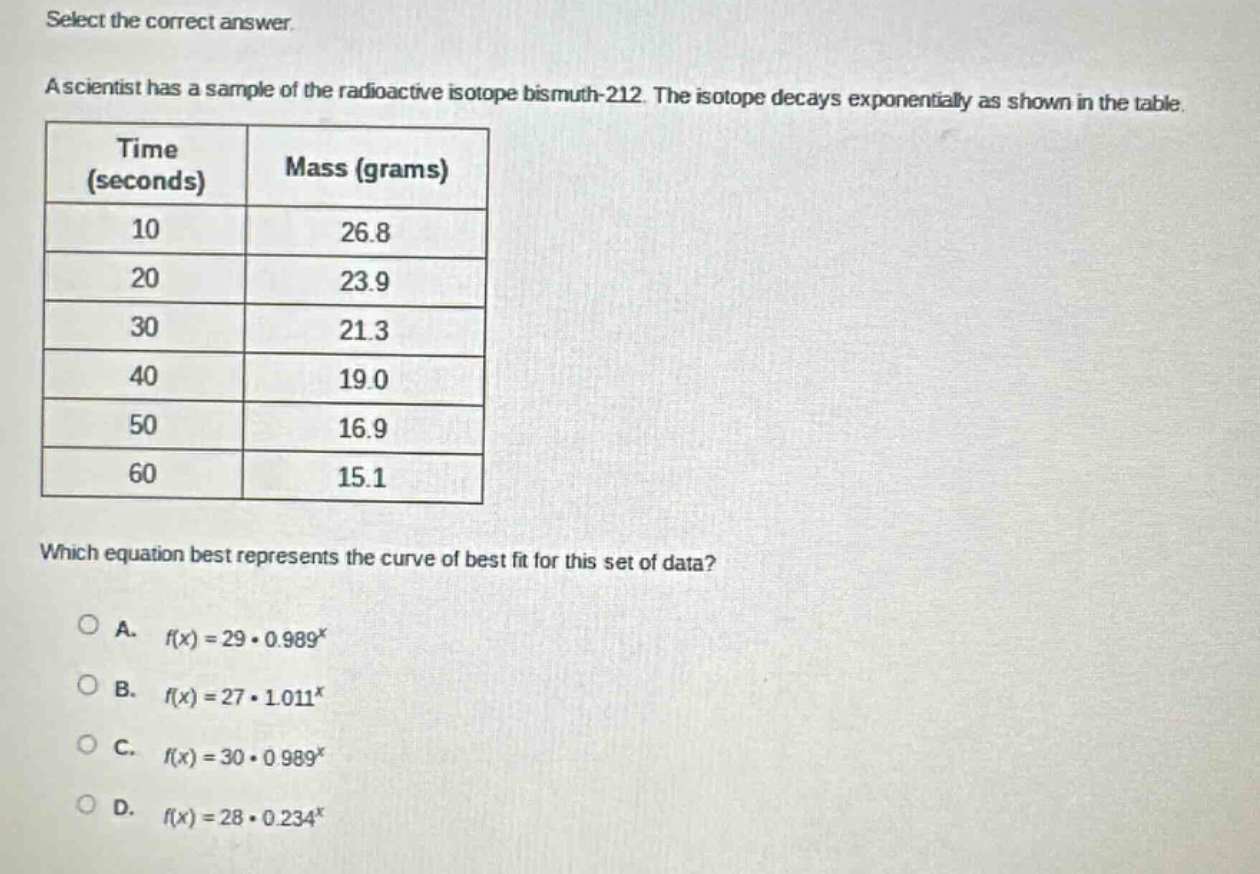
select the correct answer.\na scientist has a sample of the radioactive isotope bismuth - 212. the isotope decays exponentially as shown in the table.\n| time (seconds) | mass (grams) |\n| ---- | ---- |\n| 10 | 26.8 |\n| 20 | 23.9 |\n| 30 | 21.3 |\n| 40 | 19.0 |\n| 50 | 16.9 |\n| 60 | 15.1 |\nwhich equation best represents the curve of best fit for this set of data?\na. (f(x)=29cdot0.989^{x})\nb. (f(x)=27cdot1.011^{x})\nc. (f(x)=30cdot0.989^{x})\nd. (f(x)=28cdot0.234^{x})
Answer
Explanation:
Step1: Analyze exponential decay form
The general form of an exponential decay function is $f(x)=a\cdot b^{x}$, where $a$ is the initial - value and $0 < b<1$. Since it is decay, we can eliminate option B ($b = 1.011>1$ which represents growth).
Step2: Estimate initial - value
When $x = 0$, we can estimate the initial mass. As $x$ increases, the mass decreases. Looking at the values, when $x = 10$, $f(10)=26.8$. We know that $f(x)=a\cdot b^{x}$, so $f(10)=a\cdot b^{10}$. For an exponential decay function, as $x$ gets larger, the value of $f(x)$ gets smaller. Option D has a very small $b = 0.234$, which would cause the decay to be too rapid compared to the values in the table.
Step3: Test remaining options
For option A, $f(x)=29\cdot0.989^{x}$. When $x = 10$, $f(10)=29\cdot(0.989)^{10}\approx29\times0.896\approx25.984$. For option C, $f(x)=30\cdot0.989^{x}$. When $x = 10$, $f(10)=30\cdot(0.989)^{10}\approx30\times0.896 = 26.88$, which is closer to the value of $26.8$ in the table when $x = 10$.
Answer:
C. $f(x)=30\cdot0.989^{x}$