select the correct answer.\na sound wave enters a new medium where sound travels faster. how does this…
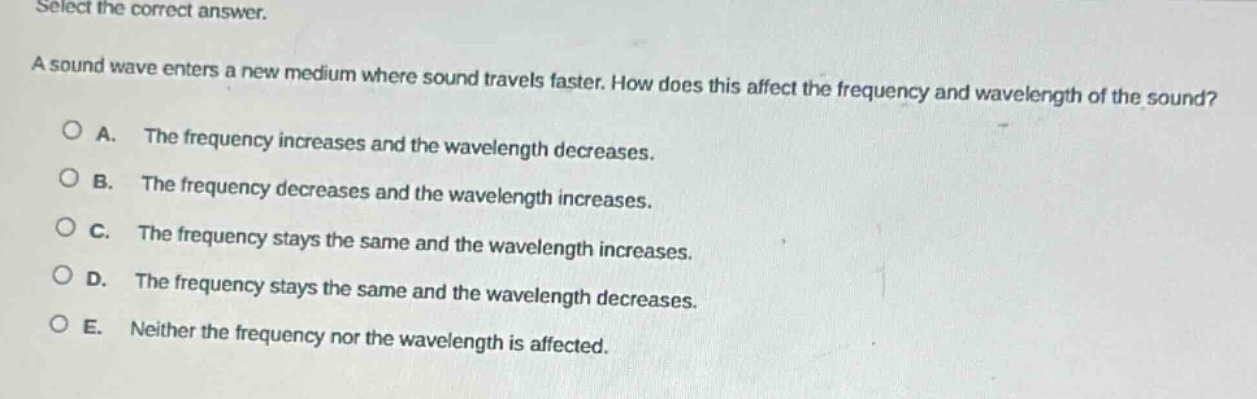
select the correct answer.\na sound wave enters a new medium where sound travels faster. how does this affect the frequency and wavelength of the sound?\na. the frequency increases and the wavelength decreases.\nb. the frequency decreases and the wavelength increases.\nc. the frequency stays the same and the wavelength increases.\nd. the frequency stays the same and the wavelength decreases.\ne. neither the frequency nor the wavelength is affected.
Answer
Brief Explanations:
The frequency of a sound wave is determined by the source and remains constant when the wave enters a new medium. The speed - wavelength - frequency relationship is $v = f\lambda$, where $v$ is the speed of sound, $f$ is the frequency, and $\lambda$ is the wavelength. If the speed $v$ increases (as the sound travels faster in the new medium) and $f$ is constant, then according to the formula, the wavelength $\lambda$ must increase.
Answer:
C. The frequency stays the same and the wavelength increases.