select the correct answer.\na tennis ball is hit into the air with a racket. when is the balls kinetic…
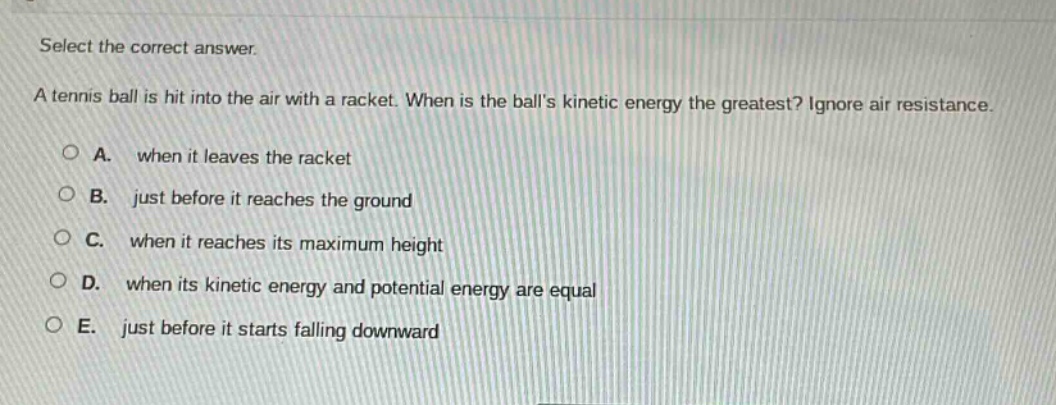
select the correct answer.\na tennis ball is hit into the air with a racket. when is the balls kinetic energy the greatest? ignore air resistance.\na. when it leaves the racket\nb. just before it reaches the ground\nc. when it reaches its maximum height\nd. when its kinetic energy and potential energy are equal\ne. just before it starts falling downward
Answer
Answer:
B. just before it reaches the ground
Explanation:
Step1: Recall energy - conservation principle
In the absence of air - resistance, the total mechanical energy (E = K+U) (kinetic energy (K) + potential energy (U)) is conserved.
Step2: Analyze potential energy changes
The potential energy (U = mgh) (where (m) is mass, (g) is gravitational acceleration, and (h) is height). As the ball moves up, (h) increases and (U) increases. As it falls, (h) decreases and (U) decreases.
Step3: Analyze kinetic energy changes
Since (E=K + U) is constant, when (U) is the smallest, (K) is the largest. The potential energy is the smallest just before the ball reaches the ground (where (h) is the smallest). So the kinetic energy is the greatest just before it reaches the ground.