select the correct answer.\ntori experiments with pulleys in physics class. she applies 70 newtons of force…
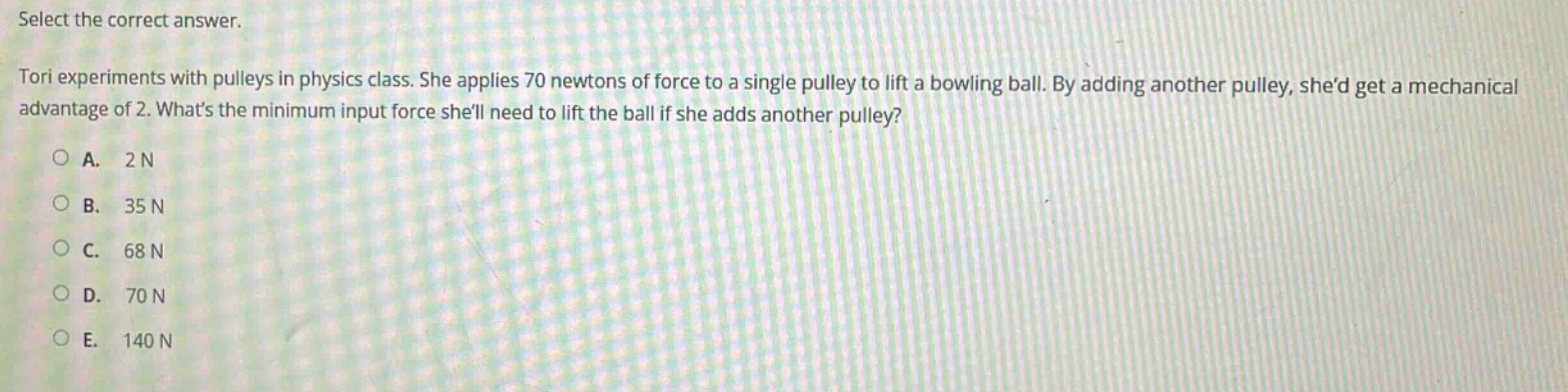
select the correct answer.\ntori experiments with pulleys in physics class. she applies 70 newtons of force to a single pulley to lift a bowling ball. by adding another pulley, shed get a mechanical advantage of 2. whats the minimum input force shell need to lift the ball if she adds another pulley?\na. 2 n\nb. 35 n\nc. 68 n\nd. 70 n\ne. 140 n
Answer
Explanation:
Step1: Recall mechanical - advantage formula
The formula for mechanical advantage (MA) is $MA=\frac{Output\ Force}{Input\ Force}$. When she first uses a single - pulley, assume the output force (weight of the bowling ball) is $F_{out}$ and the input force $F_{in1} = 70$ N. When she adds another pulley and gets a mechanical advantage of 2, we know that $MA = 2=\frac{F_{out}}{F_{in2}}$.
Step2: Find the output force
Since initially with $F_{in1}=70$ N (for a single - pulley, assume $MA = 1$), then $F_{out}=70$ N (because $MA_1 = 1=\frac{F_{out}}{F_{in1}}$).
Step3: Calculate the new input force
Using the mechanical - advantage formula $MA = 2=\frac{F_{out}}{F_{in2}}$ and $F_{out}=70$ N, we can solve for $F_{in2}$. Rearranging the formula gives $F_{in2}=\frac{F_{out}}{MA}$. Substituting $F_{out}=70$ N and $MA = 2$ into the formula, we get $F_{in2}=\frac{70}{2}=35$ N.
Answer:
B. 35 N