select the correct answer.\ntwo balls undergo inelastic collision. the y - momentum after the collision is…
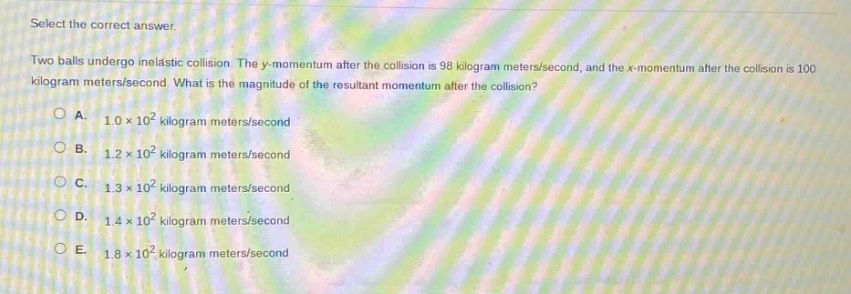
select the correct answer.\ntwo balls undergo inelastic collision. the y - momentum after the collision is 98 kilogram meters/second, and the x - momentum after the collision is 100 kilogram meters/second. what is the magnitude of the resultant momentum after the collision?\na. 1.0×10² kilogram meters/second\nb. 1.2×10² kilogram meters/second\nc. 1.3×10² kilogram meters/second\nd. 1.4×10² kilogram meters/second\ne. 1.8×10² kilogram meters/second
Answer
Explanation:
Step1: Recall the formula for magnitude of resultant vector
The magnitude of the resultant momentum $p_{resultant}$ when there are two - component momenta $p_x$ and $p_y$ is given by the Pythagorean theorem $p_{resultant}=\sqrt{p_x^{2}+p_y^{2}}$.
Step2: Substitute the given values
We are given that $p_x = 100$ kg·m/s and $p_y=98$ kg·m/s. Then $p_{resultant}=\sqrt{(100)^{2}+(98)^{2}}=\sqrt{10000 + 9604}=\sqrt{19604}$.
Step3: Calculate the square - root
$\sqrt{19604}\approx140$ kg·m/s, and $140 = 1.4\times10^{2}$ kg·m/s.
Answer:
D. $1.4\times 10^{2}$ kilogram meters/second