select the correct answer.\nyou collect a sample of gases from an indoor pool area. the sample contains air…
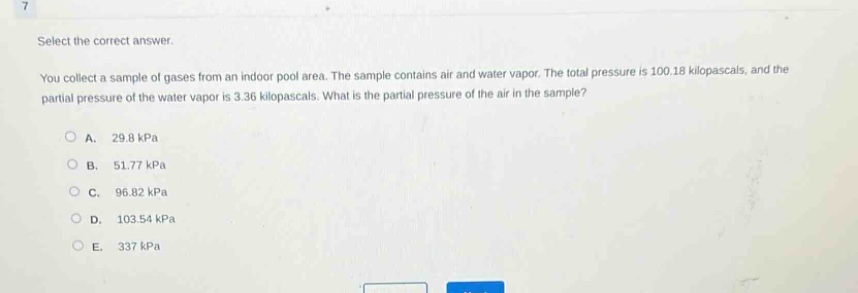
select the correct answer.\nyou collect a sample of gases from an indoor pool area. the sample contains air and water vapor. the total pressure is 100.18 kilopascals, and the partial pressure of the water vapor is 3.36 kilopascals. what is the partial pressure of the air in the sample?\na. 29.8 kpa\nb. 51.77 kpa\nc. 96.82 kpa\nd. 103.54 kpa\ne. 337 kpa
Answer
Answer:
C. 96.82 kPa
Explanation:
Step1: Recall Dalton's law
According to Dalton's law of partial - pressures, the total pressure ($P_{total}$) of a gas mixture is the sum of the partial pressures of its components. So, $P_{total}=P_{air}+P_{water\ vapor}$.
Step2: Rearrange the formula
We want to find $P_{air}$, so we can rewrite the formula as $P_{air}=P_{total}-P_{water\ vapor}$.
Step3: Substitute the given values
Given $P_{total} = 100.18$ kPa and $P_{water\ vapor}=3.36$ kPa. Then $P_{air}=100.18 - 3.36=96.82$ kPa.