select the correct answer.\nif you know that the period of a pendulum is 1.87 seconds, what is the length of…
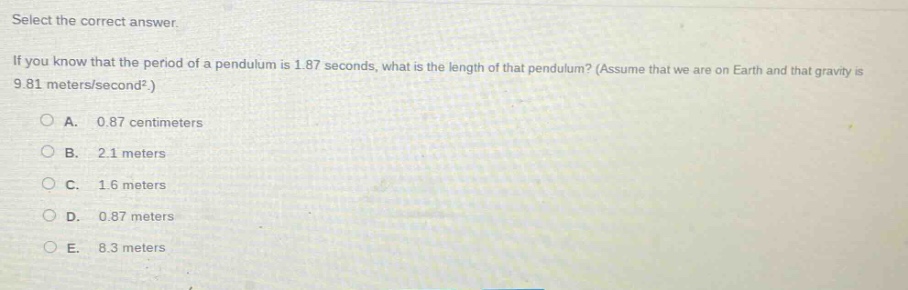
select the correct answer.\nif you know that the period of a pendulum is 1.87 seconds, what is the length of that pendulum? (assume that we are on earth and that gravity is 9.81 meters/second².)\na. 0.87 centimeters\nb. 2.1 meters\nc. 1.6 meters\nd. 0.87 meters\ne. 8.3 meters
Answer
Explanation:
Step1: Write the formula for the period of a pendulum
The formula for the period (T) of a simple pendulum is (T = 2\pi\sqrt{\frac{L}{g}}), where (T) is the period, (L) is the length of the pendulum, and (g) is the acceleration due to gravity. We need to solve for (L). First, square both sides of the equation: (T^{2}=(2\pi\sqrt{\frac{L}{g}})^{2}), which simplifies to (T^{2}=4\pi^{2}\frac{L}{g}).
Step2: Solve for (L)
Rearrange the equation (T^{2}=4\pi^{2}\frac{L}{g}) to isolate (L). Multiply both sides by (g) and then divide by (4\pi^{2}): (L=\frac{T^{2}g}{4\pi^{2}}).
Step3: Substitute the given values
We are given (T = 1.87) s and (g=9.81) m/s². Substitute these values into the formula for (L): (L=\frac{(1.87)^{2}\times9.81}{4\pi^{2}}). Calculate ((1.87)^{2}=3.4969), then (3.4969\times9.81 = 34.3046). And (4\pi^{2}\approx4\times9.8696 = 39.4784). So (L=\frac{34.3046}{39.4784}\approx0.87) m.
Answer:
D. 0.87 meters