select all the correct answers. layla is researching one of the outer planets. so far, she knows only that…
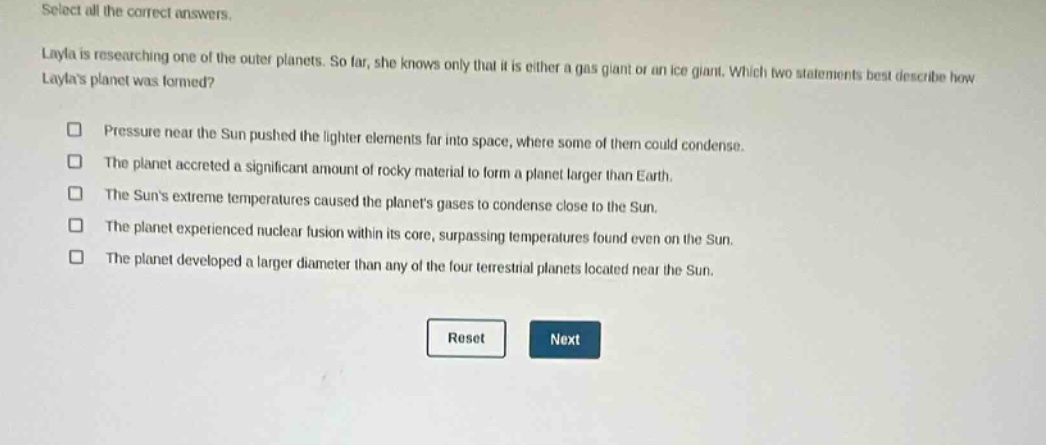
select all the correct answers. layla is researching one of the outer planets. so far, she knows only that it is either a gas giant or an ice giant. which two statements best describe how laylas planet was formed? pressure near the sun pushed the lighter elements far into space, where some of them could condense. the planet accreted a significant amount of rocky material to form a planet larger than earth. the suns extreme temperatures caused the planets gases to condense close to the sun. the planet experienced nuclear fusion within its core, surpassing temperatures found even on the sun. the planet developed a larger diameter than any of the four terrestrial planets located near the sun. reset next
Answer
Brief Explanations:
- Pressure near the Sun pushed lighter elements far into space where they could condense, which is part of the formation process of outer gas and ice giants. Outer planets formed from the accretion of material in the outer solar - nebula where lighter elements could condense.
- Outer gas and ice giants developed a larger diameter than the four terrestrial planets near the Sun. Terrestrial planets are small and rocky, while gas and ice giants are much larger in size.
The planet did not accrete a significant amount of rocky material to form a planet larger than Earth as gas and ice giants have a composition mainly of gases and ices with a small rocky core. The Sun's extreme temperatures caused the planet's gases to condense close to the Sun is incorrect as the outer planets formed far from the Sun where temperatures were low enough for ices and gases to condense. Also, the outer planets do not experience nuclear fusion within their cores like stars do.
Answer:
- Pressure near the Sun pushed the lighter elements far into space, where some of them could condense.
- The planet developed a larger diameter than any of the four terrestrial planets located near the Sun.