select the correct answers. which statements about braking a car are true? the greater the kinetic energy of…
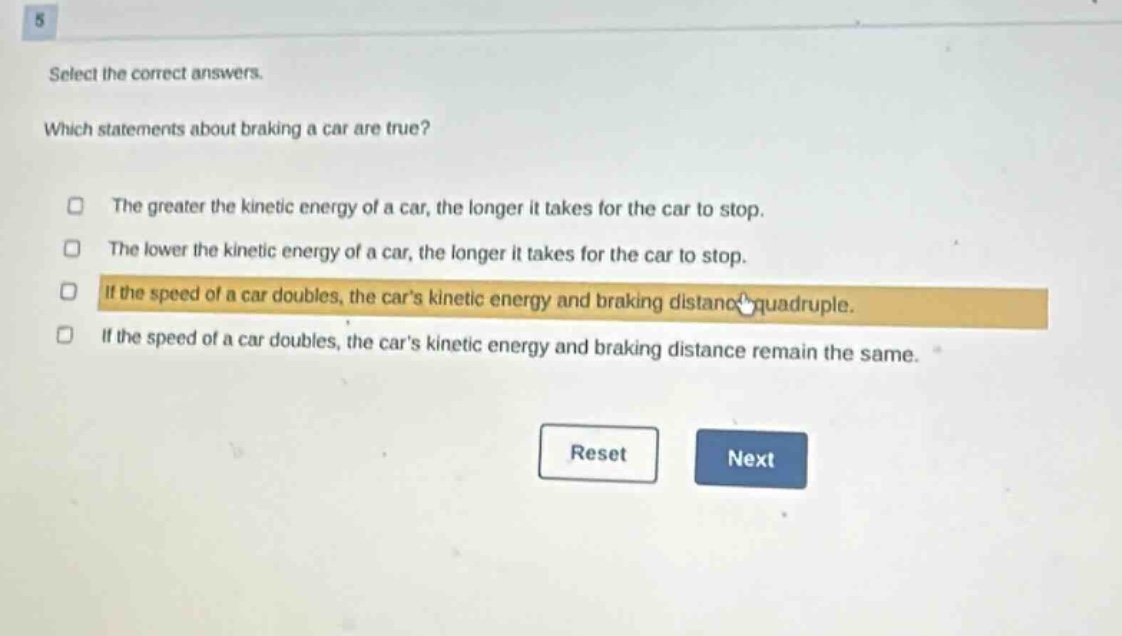
select the correct answers. which statements about braking a car are true? the greater the kinetic energy of a car, the longer it takes for the car to stop. the lower the kinetic energy of a car, the longer it takes for the car to stop. if the speed of a car doubles, the cars kinetic energy and braking distance quadruple. if the speed of a car doubles, the cars kinetic energy and braking distance remain the same.
Answer
Explanation:
Step1: Recall kinetic - energy formula
The kinetic - energy formula is $K = \frac{1}{2}mv^{2}$, where $m$ is the mass of the car and $v$ is its speed. The braking force $F$ does work $W = Fd$ to stop the car, and this work is equal to the initial kinetic energy of the car, i.e., $W = K$, so $Fd=\frac{1}{2}mv^{2}$, and $d=\frac{mv^{2}}{2F}$.
Step2: Analyze relationship between kinetic energy and stopping time
Greater kinetic energy means more work needs to be done by the brakes to stop the car. Assuming a constant braking force, more work takes more time. So, the greater the kinetic energy of a car, the longer it takes for the car to stop.
Step3: Analyze effect of speed on kinetic energy and braking distance
If the speed $v$ doubles to $2v$, the new kinetic energy $K'=\frac{1}{2}m(2v)^{2}=4\times\frac{1}{2}mv^{2}=4K$. From $d = \frac{mv^{2}}{2F}$, when $v$ doubles to $2v$, the new braking distance $d'=\frac{m(2v)^{2}}{2F}=4\times\frac{mv^{2}}{2F}=4d$.
Answer:
The greater the kinetic energy of a car, the longer it takes for the car to stop.; If the speed of a car doubles, the car's kinetic energy and braking distance quadruple.