select all the correct answers. which statements correctly describe the decay rates of radioactive isotopes…
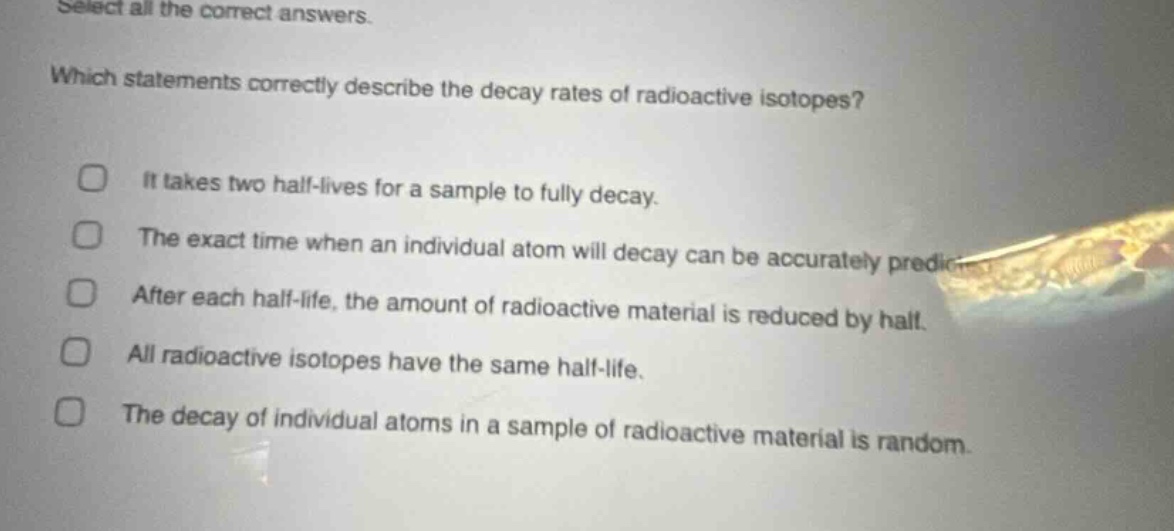
select all the correct answers. which statements correctly describe the decay rates of radioactive isotopes? it takes two half - lives for a sample to fully decay. the exact time when an individual atom will decay can be accurately predicted. after each half - life, the amount of radioactive material is reduced by half. all radioactive isotopes have the same half - life. the decay of individual atoms in a sample of radioactive material is random.
Answer
Brief Explanations:
- After one - half life, half of the radioactive material decays, and it takes an infinite number of half - lives for complete decay, so the statement "It takes two half - lives for a sample to fully decay" is incorrect.
- The decay of individual atoms is a random process and the exact time of decay of an individual atom cannot be predicted, so "The exact time when an individual atom will decay can be accurately predicted" is incorrect.
- By definition, after each half - life, the amount of radioactive material is reduced by half.
- Different radioactive isotopes have different half - lives.
- The decay of individual atoms in a sample of radioactive material is indeed a random process.
Answer:
C. After each half - life, the amount of radioactive material is reduced by half. E. The decay of individual atoms in a sample of radioactive material is random.