select the correct sentences on the image. matthew throws a ball straight up into the air. it rises for a…
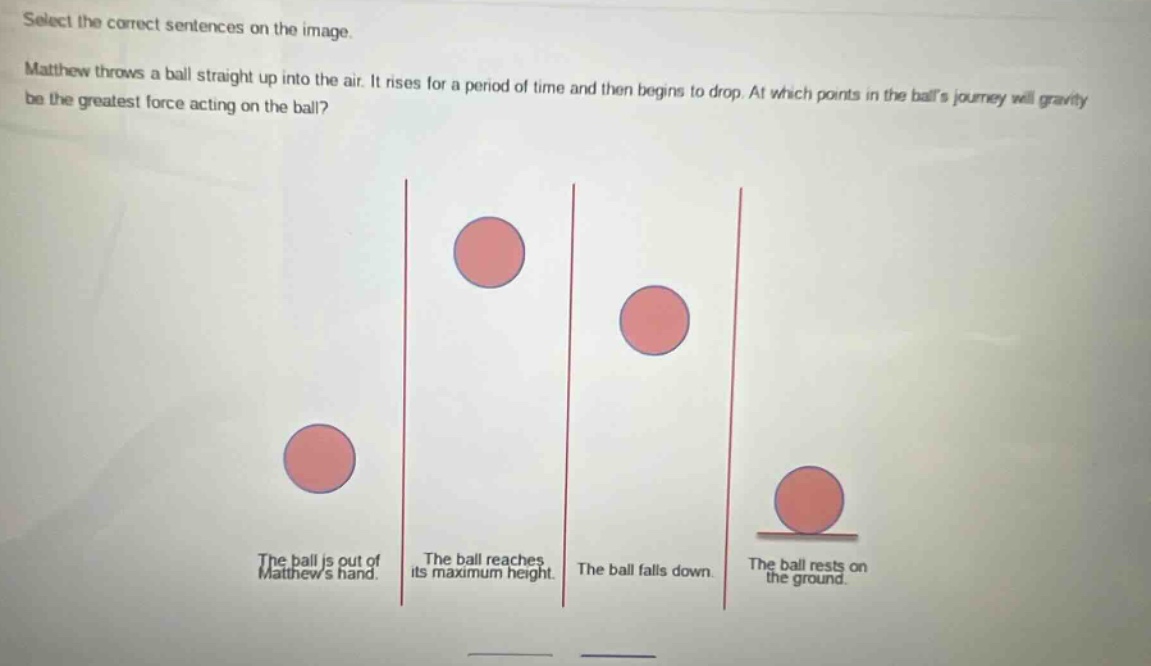
select the correct sentences on the image. matthew throws a ball straight up into the air. it rises for a period of time and then begins to drop. at which points in the balls journey will gravity be the greatest force acting on the ball? the ball is out of matthews hand. the ball reaches its maximum height. the ball falls down. the ball rests on the ground.
Answer
Explanation:
Step1: Recall gravitational force formula
The gravitational force on an object near the Earth's surface is given by $F = mg$, where $m$ is the mass of the object and $g$ is the acceleration due to gravity. As long as the ball is in - Earth's gravitational field and its mass doesn't change, the gravitational force acting on it is constant.
Step2: Analyze each situation
When the ball is out of Matthew's hand, in mid - air (rising, at maximum height, or falling), and when it rests on the ground, the mass $m$ of the ball and the value of $g$ (approx. $9.8\ m/s^{2}$ near the Earth's surface) remain the same. So the gravitational force is the same in all these situations. But if we consider the context of the question asking when gravity is the "greatest force acting on the ball", we assume no other significant non - gravitational forces in most of the journey. When the ball is out of Matthew's hand, rising, at maximum height, and falling, the main force acting on it is gravity (neglecting air resistance). When the ball rests on the ground, there is a normal force acting on it which balances the gravitational force. So in the situations where the ball is out of Matthew's hand, reaches its maximum height, and falls down, gravity is the greatest force acting on the ball.
Answer:
The ball is out of Matthew's hand, The ball reaches its maximum height, The ball falls down