a series circuit contains a 30 ω resistor, a 20 ω resistor, and a 10 ω resistor. the power supply provides…
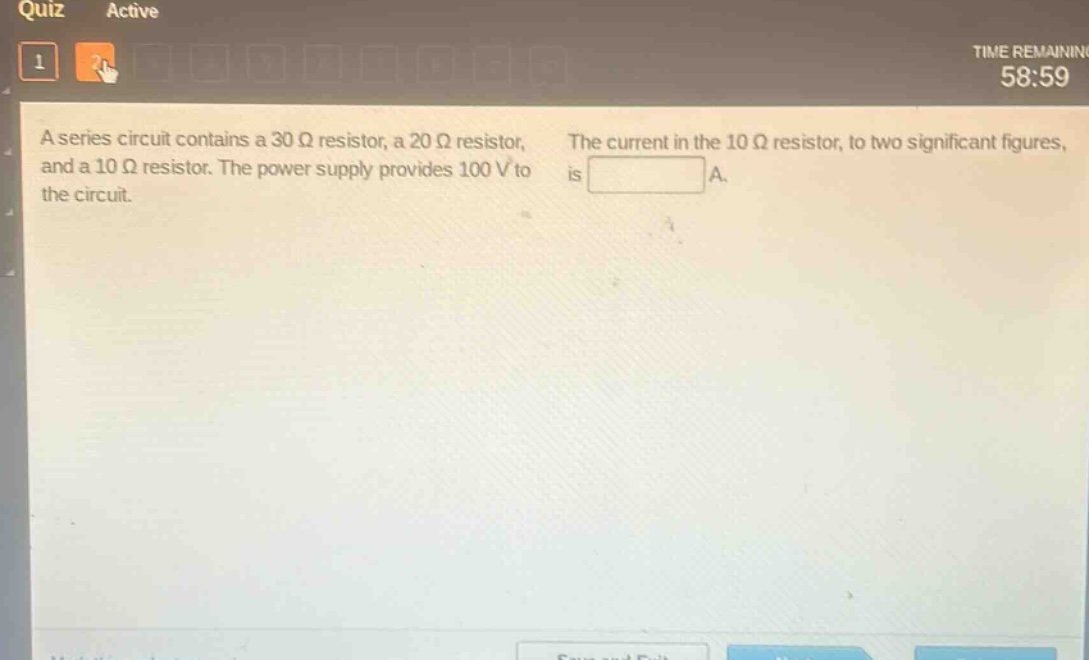
a series circuit contains a 30 ω resistor, a 20 ω resistor, and a 10 ω resistor. the power supply provides 100 v to the circuit. the current in the 10 ω resistor, to two significant figures, is a.
Answer
Explanation:
Step1: Calculate total resistance
In a series - circuit, the total resistance $R_{total}$ is the sum of individual resistances. So, $R_{total}=30 + 20+10=60\ \Omega$.
Step2: Use Ohm's law
Ohm's law is $V = IR$, where $V$ is voltage, $I$ is current, and $R$ is resistance. We know $V = 100\ V$ and $R = R_{total}=60\ \Omega$. Rearranging for current $I=\frac{V}{R}$. So, $I=\frac{100}{60}=\frac{5}{3}\approx1.7\ A$. In a series - circuit, the current is the same throughout the circuit. So the current in the $10\ \Omega$ resistor is also $\frac{5}{3}\ A\approx1.7\ A$.
Answer:
$1.7$