2. a simple pendulum has a length of 20 cm and a maximum horizontal displacement of 8 cm.\na) determine a…
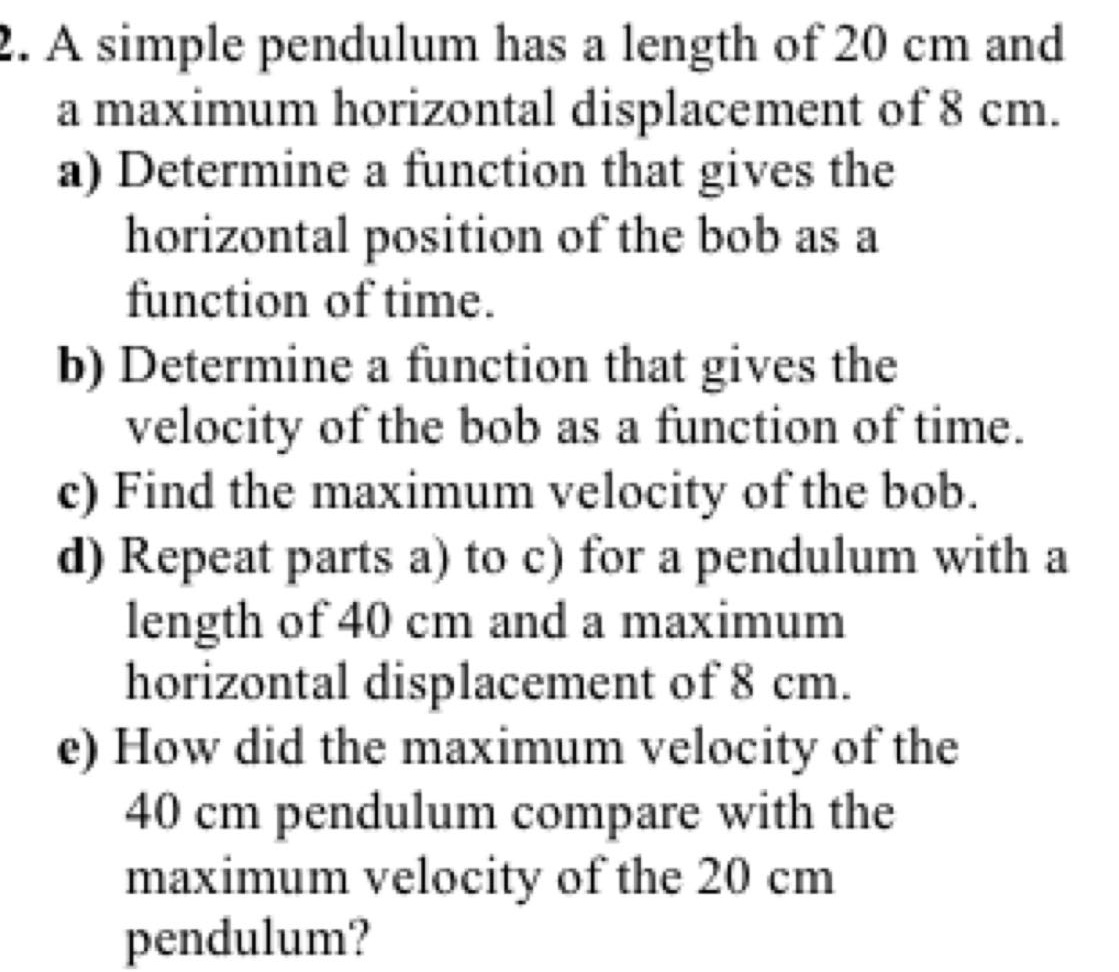
2. a simple pendulum has a length of 20 cm and a maximum horizontal displacement of 8 cm.\na) determine a function that gives the horizontal position of the bob as a function of time.\nb) determine a function that gives the velocity of the bob as a function of time.\nc) find the maximum velocity of the bob.\nd) repeat parts a) to c) for a pendulum with a length of 40 cm and a maximum horizontal displacement of 8 cm.\ne) how did the maximum velocity of the 40 cm pendulum compare with the maximum velocity of the 20 cm pendulum?
Answer
Explanation:
Step1: Recall the formula for simple - harmonic motion of a pendulum
The horizontal position of a simple pendulum in simple - harmonic motion is given by $x(t)=A\cos(\omega t+\varphi)$. At $t = 0$, if we assume the pendulum is at its maximum displacement, $\varphi = 0$. The angular frequency $\omega=\sqrt{\frac{g}{L}}$, where $g = 9.8\ m/s^{2}$ and $L$ is the length of the pendulum, and $A$ is the amplitude (maximum horizontal displacement).
Step2: Calculate the angular frequency for $L = 20\ cm=0.2\ m$
$\omega_1=\sqrt{\frac{g}{L_1}}=\sqrt{\frac{9.8}{0.2}}\ rad/s\approx\sqrt{49}=7\ rad/s$. The amplitude $A = 8\ cm = 0.08\ m$. So the horizontal position function is $x_1(t)=0.08\cos(7t)$.
Step3: Differentiate the position function to get the velocity function
The velocity function $v(t)$ is the derivative of the position function $x(t)$. Using the chain - rule, if $x(t)=A\cos(\omega t)$, then $v(t)=-A\omega\sin(\omega t)$. For $x_1(t)=0.08\cos(7t)$, $v_1(t)=-0.08\times7\sin(7t)= - 0.56\sin(7t)$.
Step4: Find the maximum velocity
The maximum value of $\sin(\omega t)$ is 1. So the maximum velocity $v_{1max}=0.56\ m/s$.
Step5: Calculate for $L = 40\ cm = 0.4\ m$
$\omega_2=\sqrt{\frac{g}{L_2}}=\sqrt{\frac{9.8}{0.4}}\ rad/s\approx\sqrt{24.5}\approx4.95\ rad/s$. The amplitude $A = 0.08\ m$. The horizontal position function is $x_2(t)=0.08\cos(4.95t)$.
Step6: Find the velocity function for $L = 40\ cm$
Differentiating $x_2(t)=0.08\cos(4.95t)$ gives $v_2(t)=-0.08\times4.95\sin(4.95t)=-0.396\sin(4.95t)$.
Step7: Find the maximum velocity for $L = 40\ cm$
The maximum value of $\sin(\omega t)$ is 1, so $v_{2max}=0.396\ m/s$.
Step8: Compare the maximum velocities
$\frac{v_{2max}}{v_{1max}}=\frac{0.396}{0.56}\approx0.71$. The maximum velocity of the 40 - cm pendulum is approximately 0.71 times the maximum velocity of the 20 - cm pendulum.
Answer:
a) $x_1(t)=0.08\cos(7t)$ b) $v_1(t)=-0.56\sin(7t)$ c) $0.56\ m/s$ d) $x_2(t)=0.08\cos(4.95t)$, $v_2(t)=-0.396\sin(4.95t)$, $0.396\ m/s$ e) The maximum velocity of the 40 - cm pendulum is approximately 0.71 times the maximum velocity of the 20 - cm pendulum.