situation 5: select any five people, 3 on one side, two on the other, . move them up to the rope in any…
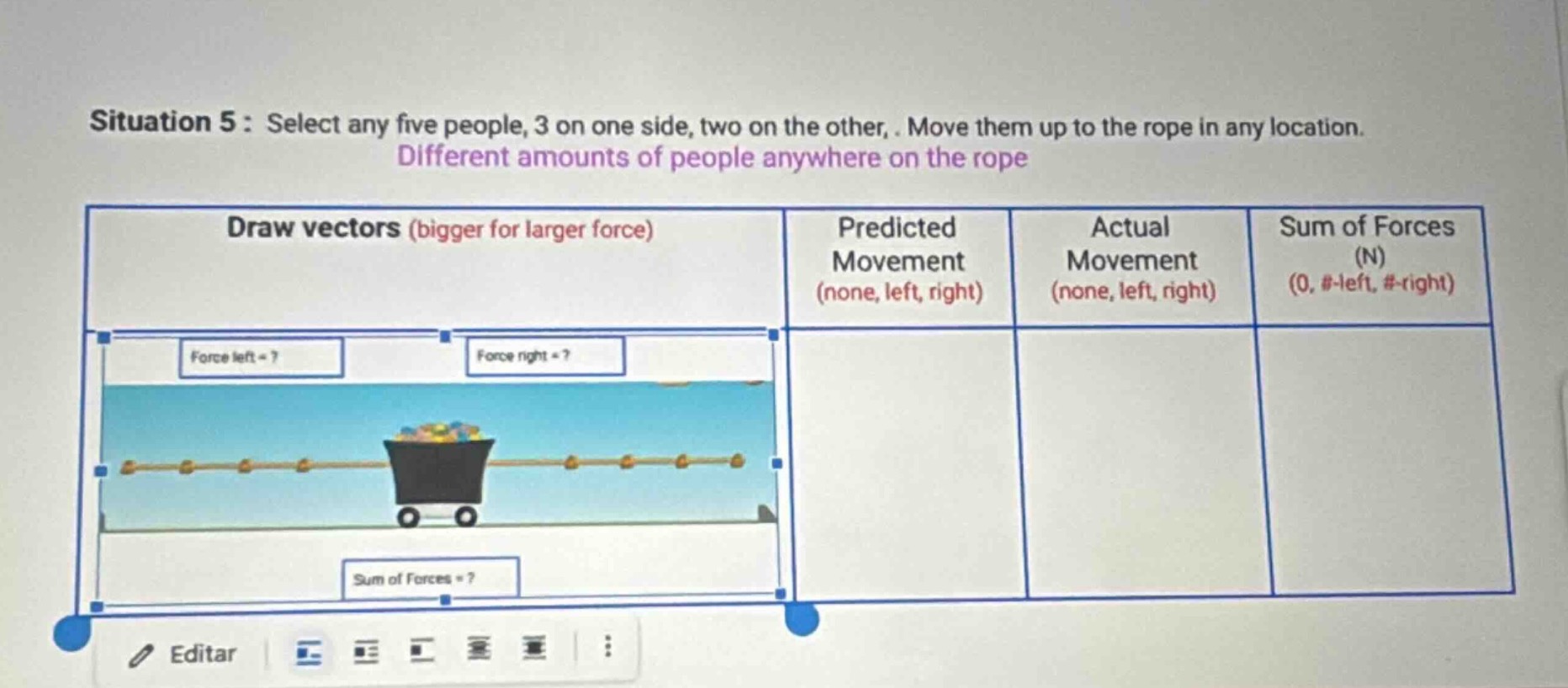
situation 5: select any five people, 3 on one side, two on the other, . move them up to the rope in any location.\ndifferent amounts of people anywhere on the rope\ndraw vectors (bigger for larger force)\npredicted movement (none, left, right)\nactual movement (none, left, right)\nsum of forces (n) (0, #-left, #-right)\nforce left = ?\nforce right = ?\nsum of forces = ?
Answer
Explanation:
Step1: Asignar fuerza por persona
Supongamos que cada persona ejerce una fuerza de $1\ \text{N}$. Si hay 3 personas a la izquierda y 2 a la derecha: Fuerza izquierda: $F_{izq} = 3\ \text{N}$ Fuerza derecha: $F_{der} = 2\ \text{N}$
Step2: Calcular suma de fuerzas
La suma de fuerzas es la diferencia entre la fuerza mayor y la menor, en la dirección de la fuerza mayor. $$F_{total} = F_{izq} - F_{der} = 3 - 2 = 1\ \text{N}$$
Step3: Predecir movimiento
El movimiento se dirige hacia el lado con mayor fuerza (izquierda). El movimiento actual coincide con la predicción si no hay fuerzas externas adicionales.
Answer:
- Draw vectors: Dibujar un vector más largo hacia la izquierda (representando $3\ \text{N}$) y uno más corto hacia la derecha (representando $2\ \text{N}$)
- Predicted Movement: left
- Actual Movement: left
- Sum of Forces (N): $1$-left
- Force left =: $3\ \text{N}$
- Force right =: $2\ \text{N}$
- Sum of Forces =: $1\ \text{N}$ hacia la izquierda