6. a skier starts from rest at the top of a frictionless incline of height 20.0 m. at the bottom of the…
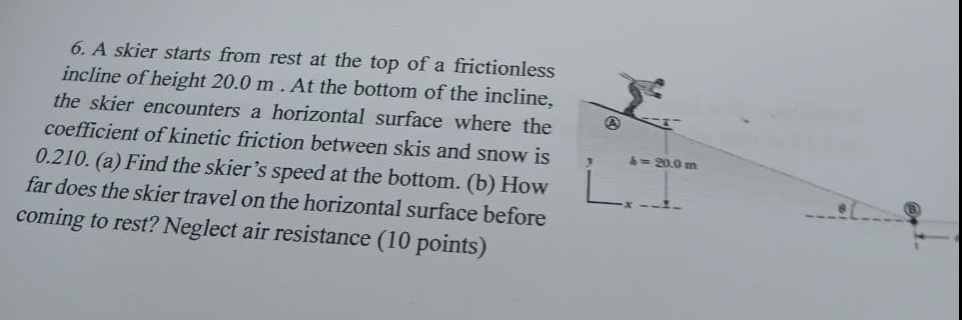
6. a skier starts from rest at the top of a frictionless incline of height 20.0 m. at the bottom of the incline, the skier encounters a horizontal surface where the coefficient of kinetic friction between skis and snow is 0.210. (a) find the skiers speed at the bottom. (b) how far does the skier travel on the horizontal surface before coming to rest? neglect air resistance (10 points)
Answer
Explanation:
Step1: Use conservation of mechanical energy for part (a)
The initial potential - energy at the top of the incline is converted into kinetic energy at the bottom. The initial potential energy of the skier is $U = mgh$, and the kinetic energy at the bottom is $K=\frac{1}{2}mv^{2}$. By the conservation of mechanical energy $U = K$, so $mgh=\frac{1}{2}mv^{2}$. Canceling out the mass $m$ on both sides, we get $v=\sqrt{2gh}$. Given $h = 20.0\ m$ and $g = 9.8\ m/s^{2}$, then $v=\sqrt{2\times9.8\times20.0}=\sqrt{392}\approx 19.8\ m/s$.
Step2: Analyze the forces and use kinematic equations for part (b)
The frictional force on the horizontal surface is $F_f=\mu_k N$, where $N = mg$ (since the normal force equals the weight on a horizontal surface). So $F_f=\mu_kmg$. According to Newton's second - law $F = ma$, and $F_f=ma$, then $\mu_kmg=ma$, and the acceleration $a=-\mu_kg$. The kinematic equation $v_f^{2}-v_i^{2}=2ax$ is used, where $v_f = 0$ (the skier comes to rest), $v_i$ is the speed at the bottom of the incline, and $a=-\mu_kg$. We know $v_i\approx19.8\ m/s$, $\mu_k = 0.210$, and $g = 9.8\ m/s^{2}$. From $v_f^{2}-v_i^{2}=2ax$, we can solve for $x$: [ \begin{align*} 0 - v_i^{2}&=2(-\mu_kg)x\ x&=\frac{v_i^{2}}{2\mu_kg} \end{align*} ] Substitute $v_i\approx19.8\ m/s$, $\mu_k = 0.210$, and $g = 9.8\ m/s^{2}$ into the formula: [ \begin{align*} x&=\frac{(19.8)^{2}}{2\times0.210\times9.8}\ &=\frac{392.04}{4.116}\ &\approx95.2\ m \end{align*} ]
Answer:
(a) The skier's speed at the bottom is approximately $19.8\ m/s$. (b) The skier travels approximately $95.2\ m$ on the horizontal surface before coming to rest.