a sled that has a mass of 8 kg is pulled at a 50 degree angle with a force of 20 n. the force of friction…
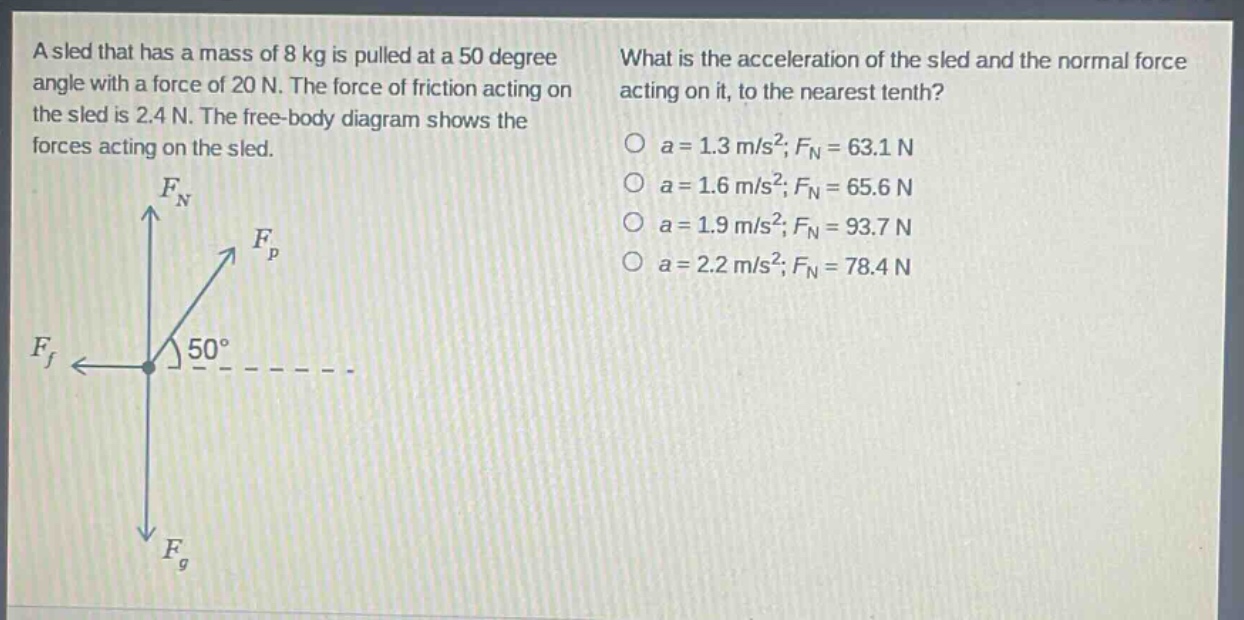
a sled that has a mass of 8 kg is pulled at a 50 degree angle with a force of 20 n. the force of friction acting on the sled is 2.4 n. the free - body diagram shows the forces acting on the sled. what is the acceleration of the sled and the normal force acting on it, to the nearest tenth? o a = 1.3 m/s²; f_n = 63.1 n o a = 1.6 m/s²; f_n = 65.6 n o a = 1.9 m/s²; f_n = 93.7 n o a = 2.2 m/s²; f_n = 78.4 n
Answer
Answer:
A. $a = 1.3\ m/s^{2};F_N=63.1\ N$
Explanation:
Step1: Resolve the pulling - force horizontally
The horizontal component of the pulling force $F_{p,x}=F_p\cos\theta$, where $F_p = 20\ N$ and $\theta = 50^{\circ}$. So $F_{p,x}=20\cos50^{\circ}\approx20\times0.643 = 12.86\ N$.
Step2: Calculate the acceleration using Newton's second law
According to Newton's second law $F_{net,x}=ma$, and $F_{net,x}=F_{p,x}-F_f$. Given $F_f = 2.4\ N$ and $m = 8\ kg$. Then $a=\frac{F_{p,x}-F_f}{m}=\frac{12.86 - 2.4}{8}=\frac{10.46}{8}\approx1.3\ m/s^{2}$.
Step3: Resolve the pulling - force vertically
The vertical component of the pulling force $F_{p,y}=F_p\sin\theta$, where $F_p = 20\ N$ and $\theta = 50^{\circ}$. So $F_{p,y}=20\sin50^{\circ}\approx20\times0.766 = 15.32\ N$.
Step4: Calculate the normal force
The gravitational force $F_g=mg$, with $m = 8\ kg$ and $g = 9.8\ m/s^{2}$, so $F_g=8\times9.8 = 78.4\ N$. In the vertical direction, $F_N+F_{p,y}=F_g$. Then $F_N=F_g - F_{p,y}=78.4-15.32 = 63.08\approx63.1\ N$.