a soccer ball is dropped from a height of 2 m and falls to the floor. what is the relationship of the…
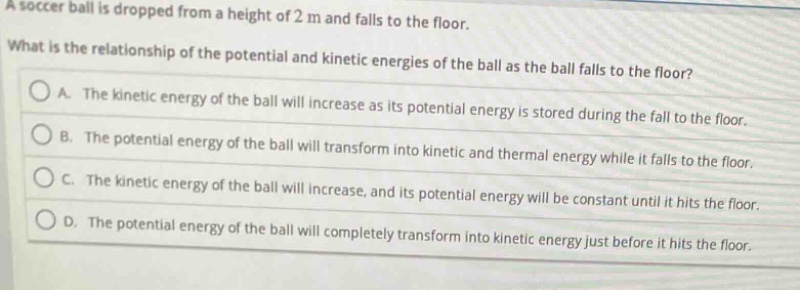
a soccer ball is dropped from a height of 2 m and falls to the floor. what is the relationship of the potential and kinetic energies of the ball as the ball falls to the floor? a. the kinetic energy of the ball will increase as its potential energy is stored during the fall to the floor. b. the potential energy of the ball will transform into kinetic and thermal energy while it falls to the floor. c. the kinetic energy of the ball will increase, and its potential energy will be constant until it hits the floor. d. the potential energy of the ball will completely transform into kinetic energy just before it hits the floor.
Answer
Explanation:
Step1: Recall energy - conservation principle
As the ball falls, its mechanical energy (sum of potential and kinetic energy) is conserved in the absence of non - conservative forces (neglecting air resistance here). The initial potential energy (U = mgh) (where (m) is mass, (g) is acceleration due to gravity, and (h) is height) starts to convert into kinetic energy (K=\frac{1}{2}mv^{2}) as the height (h) decreases and the velocity (v) increases. Also, in a real - world scenario, some energy is dissipated as thermal energy due to air resistance.
Step2: Analyze each option
- Option A: Potential energy is not stored during the fall. It is converted into other forms of energy, so A is incorrect.
- Option B: As the ball falls, its potential energy (mgh) decreases. Some of it is converted into kinetic energy (\frac{1}{2}mv^{2}) and some is dissipated as thermal energy due to air resistance. This option is correct.
- Option C: Potential energy decreases as the height (h) decreases, not remains constant, so C is incorrect.
- Option D: In a real - world situation, due to air resistance, the potential energy does not completely transform into kinetic energy just before hitting the floor. Some energy is lost as thermal energy, so D is incorrect.
Answer:
B. The potential energy of the ball will transform into kinetic and thermal energy while it falls to the floor.