a soccer ball is kicked into the air from the ground. if the ball reaches a maximum height of 25 ft and…
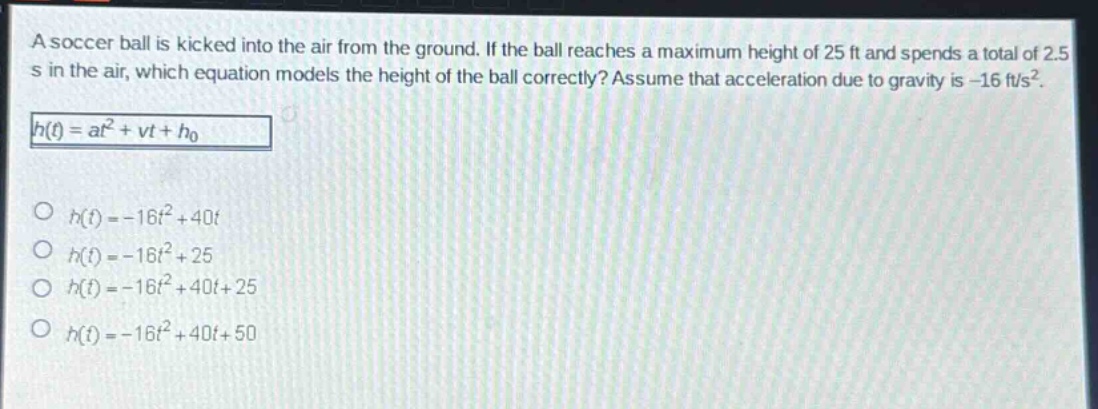
a soccer ball is kicked into the air from the ground. if the ball reaches a maximum height of 25 ft and spends a total of 2.5 s in the air, which equation models the height of the ball correctly? assume that acceleration due to gravity is -16 ft/s². (h(t)=at^{2}+vt + h_{0}) (h(t)=-16t^{2}+40t) (h(t)=-16t^{2}+25) (h(t)=-16t^{2}+40t + 25) (h(t)=-16t^{2}+40t + 50)
Answer
Explanation:
Step1: Determine the initial - height
The ball is kicked from the ground, so $h_0 = 0$. The general equation of motion is $h(t)=at^{2}+vt + h_0$, and since $h_0 = 0$, the equation becomes $h(t)=at^{2}+vt$. The acceleration due to gravity $a=- 16$ ft/s², so $h(t)=-16t^{2}+vt$.
Step2: Use the time - of - flight information
The time of flight $T = 2.5$ s. For a projectile motion, the time of flight $T$ is given by the formula $T=\frac{-v}{a}$ (when $h_0 = 0$). Substituting $a=-16$ ft/s² and $T = 2.5$ s into $T=\frac{-v}{a}$, we have $2.5=\frac{-v}{-16}$. Solving for $v$: [v = 16\times2.5=40]
Step3: Write the height equation
Substitute $a=-16$ and $v = 40$ into $h(t)=at^{2}+vt$. We get $h(t)=-16t^{2}+40t$.
Answer:
$h(t)=-16t^{2}+40t$ (corresponding to the first option)