a soccer player kicks a ball, and the height of the ball in feet as a function of time in seconds can be…
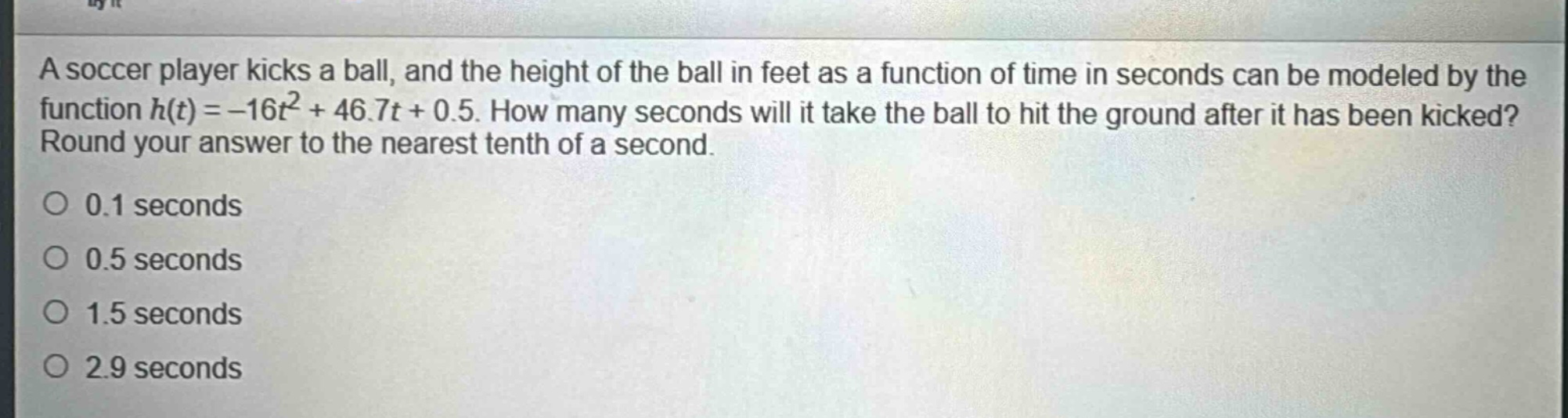
a soccer player kicks a ball, and the height of the ball in feet as a function of time in seconds can be modeled by the function $h(t)=-16t^{2}+46.7t + 0.5$. how many seconds will it take the ball to hit the ground after it has been kicked? round your answer to the nearest tenth of a second.\n0.1 seconds\n0.5 seconds\n1.5 seconds\n2.9 seconds
Answer
Explanation:
Step1: Set height to 0
When the ball hits the ground, $h(t)=0$. So we set $-16t^{2}+46.7t + 0.5=0$.
Step2: Identify coefficients
For the quadratic equation $ax^{2}+bx + c = 0$, here $a=-16$, $b = 46.7$, $c=0.5$.
Step3: Apply quadratic formula
The quadratic formula is $t=\frac{-b\pm\sqrt{b^{2}-4ac}}{2a}$. Substitute the values: $t=\frac{-46.7\pm\sqrt{(46.7)^{2}-4\times(-16)\times0.5}}{2\times(-16)}$.
Step4: Calculate discriminant
First, calculate the discriminant $\Delta=b^{2}-4ac=(46.7)^{2}-4\times(-16)\times0.5=2180.89 + 32=2212.89$.
Step5: Find t - values
$t=\frac{-46.7\pm\sqrt{2212.89}}{-32}=\frac{-46.7\pm47.04}{-32}$. We get two solutions for $t$: $t_1=\frac{-46.7 + 47.04}{-32}=\frac{0.34}{-32}\approx - 0.01$ (rejected as time can't be negative) $t_2=\frac{-46.7-47.04}{-32}=\frac{-93.74}{-32}\approx2.9$.
Answer:
D. 2.9 seconds