a softball pitcher throws a softball to a catcher behind home plate. the softball is 3 feet above the ground…
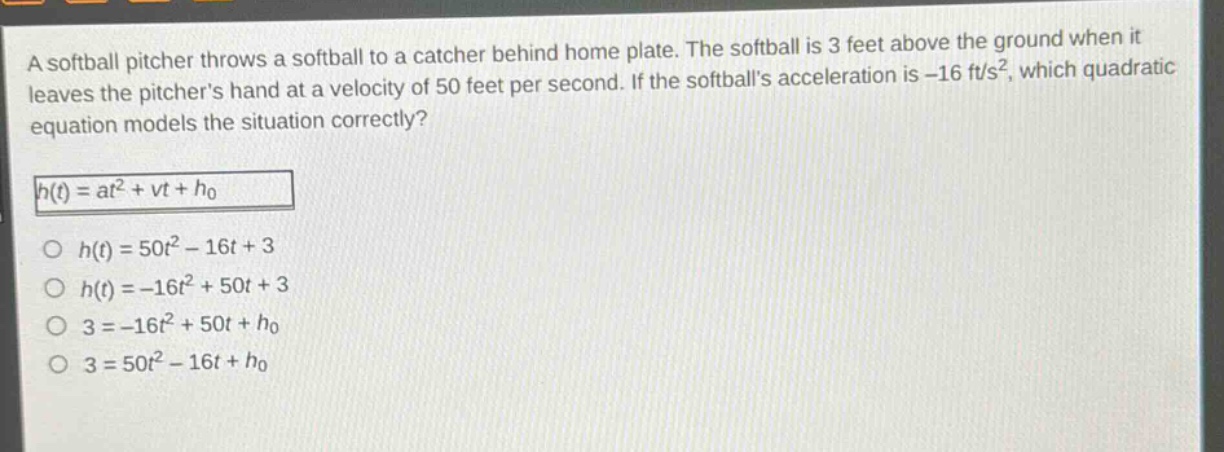
a softball pitcher throws a softball to a catcher behind home plate. the softball is 3 feet above the ground when it leaves the pitchers hand at a velocity of 50 feet per second. if the softballs acceleration is -16 ft/s², which quadratic equation models the situation correctly?\nh(t)=at² + vt+h₀\n○ h(t)=50t² - 16t + 3\n○ h(t)= - 16t²+50t + 3\n○ 3=-16t² + 50t+h₀\n○ 3 = 50t²-16t+h₀
Answer
Explanation:
Step1: Identify the values
The general height - time equation is $h(t)=at^{2}+vt + h_{0}$, where $a$ is the acceleration, $v$ is the initial velocity, and $h_{0}$ is the initial height. Given $a=- 16$ ft/s², $v = 50$ ft/s, and $h_{0}=3$ ft.
Step2: Substitute the values
Substitute $a=-16$, $v = 50$, and $h_{0}=3$ into the equation $h(t)=at^{2}+vt + h_{0}$. We get $h(t)=-16t^{2}+50t + 3$.
Answer:
$h(t)=-16t^{2}+50t + 3$