sora is testing how electric forces can change. she charges two rubber balloons with equal amounts of…
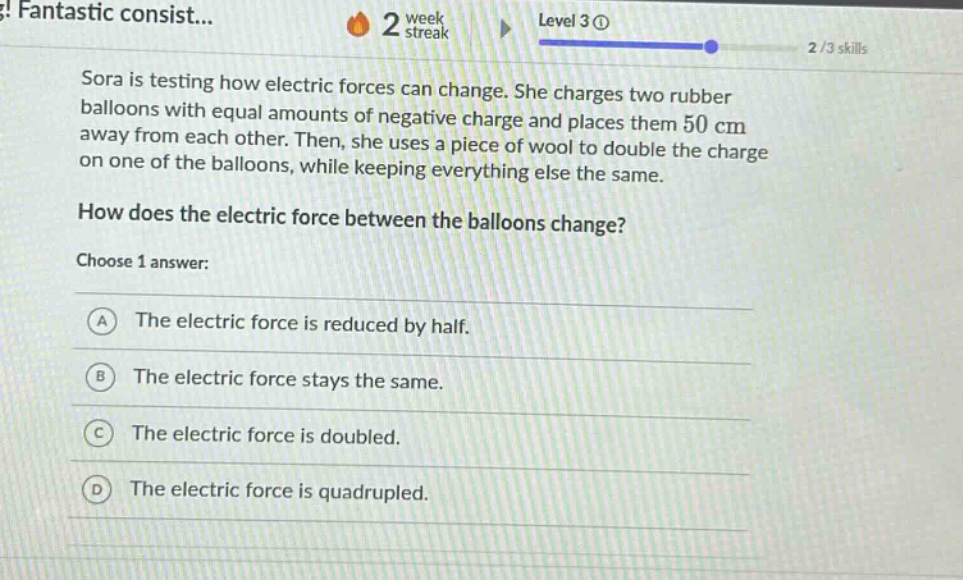
sora is testing how electric forces can change. she charges two rubber balloons with equal amounts of negative charge and places them 50 cm away from each other. then, she uses a piece of wool to double the charge on one of the balloons, while keeping everything else the same. how does the electric force between the balloons change? choose 1 answer: a the electric force is reduced by half. b the electric force stays the same. c the electric force is doubled. d the electric force is quadrupled.
Answer
Explanation:
Step1: Recall Coulomb's law
The electric - force between two charged objects is given by $F = k\frac{q_1q_2}{r^2}$, where $k$ is the Coulomb's constant, $q_1$ and $q_2$ are the charges of the two objects, and $r$ is the distance between them.
Step2: Analyze the initial situation
Let the initial charges on the two balloons be $q_1 = q$ and $q_2 = q$, and the distance $r$ is constant. So the initial force $F_1=k\frac{q\times q}{r^2}=k\frac{q^{2}}{r^2}$.
Step3: Analyze the final situation
After doubling the charge on one of the balloons, $q_1 = 2q$ and $q_2 = q$ (while $r$ remains the same). Then the final force $F_2=k\frac{(2q)\times q}{r^2}=2k\frac{q^{2}}{r^2}$.
Step4: Compare the initial and final forces
We can see that $F_2 = 2F_1$.
Answer:
C. The electric force is doubled.