sound waves\nbased on the data in the table, which function models the frequency, y, in waves per second, of…
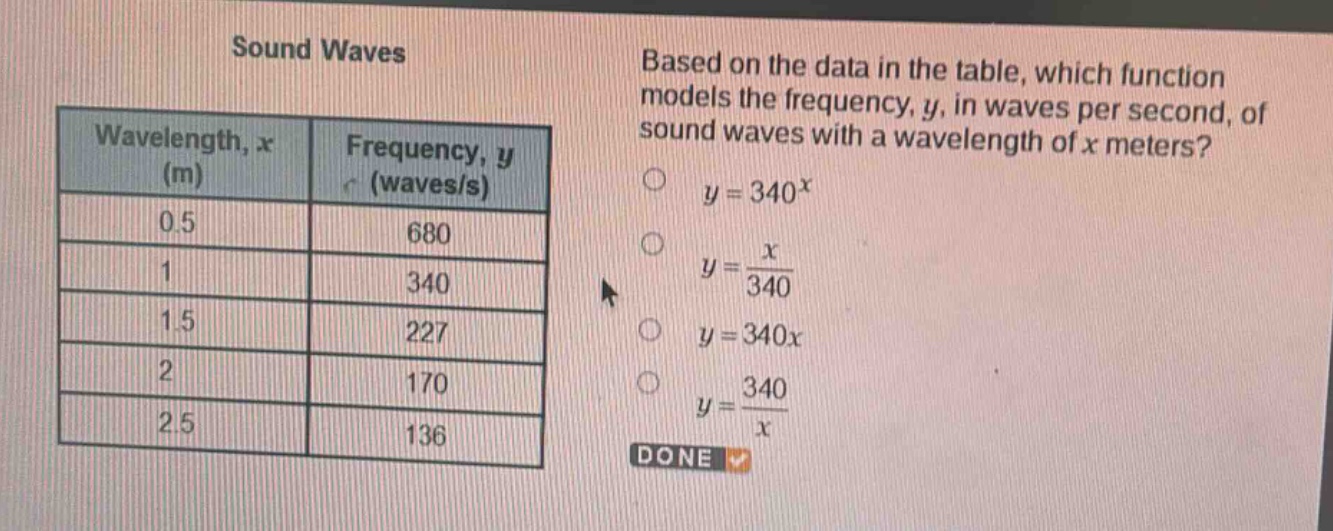
sound waves\nbased on the data in the table, which function models the frequency, y, in waves per second, of sound waves with a wavelength of x meters?\nwavelength, x (m) frequency, y (waves/s)\n0.5 680\n1 340\n1.5 227\n2 170\n2.5 136\n$y = 340^{x}$\n$y=\frac{x}{340}$\n$y = 340x$\n$y=\frac{340}{x}$\ndone
Answer
Explanation:
Step1: Comprobar la relación entre longitud de onda y frecuencia
Multiplicamos los valores de $x$ y $y$ de cada fila de la tabla. Para $x = 0.5$ y $y=680$, $0.5\times680 = 340$. Para $x = 1$ y $y = 340$, $1\times340=340$. Para $x = 1.5$ y $y\approx227$, $1.5\times227 = 340.5\approx340$. Para $x = 2$ y $y = 170$, $2\times170=340$. Para $x = 2.5$ y $y = 136$, $2.5\times136=340$. Vemos que $x\times y=340$, entonces $y=\frac{340}{x}$.
Answer:
$y=\frac{340}{x}$