the specific heat of water is 4.18 j/(g,°c) and that of wood is 1.97 j/(g,°c). which statement is…
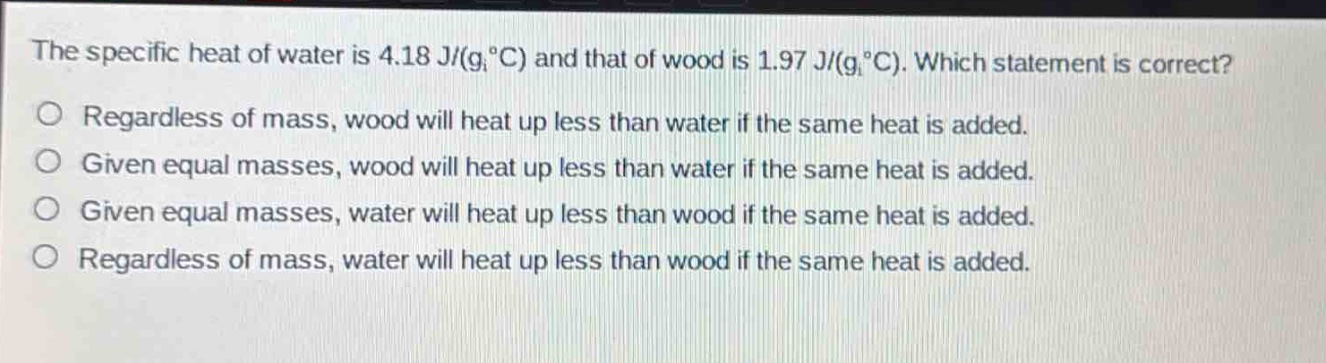
the specific heat of water is 4.18 j/(g,°c) and that of wood is 1.97 j/(g,°c). which statement is correct?\no regardless of mass, wood will heat up less than water if the same heat is added.\no given equal masses, wood will heat up less than water if the same heat is added.\no given equal masses, water will heat up less than wood if the same heat is added.\no regardless of mass, water will heat up less than wood if the same heat is added.
Answer
Explanation:
Step1: Recall specific - heat formula
The formula for heat transfer is $Q = mc\Delta T$, where $Q$ is the heat added, $m$ is the mass, $c$ is the specific - heat capacity, and $\Delta T$ is the change in temperature. We can solve for $\Delta T$: $\Delta T=\frac{Q}{mc}$.
Step2: Analyze the effect of specific - heat
When $Q$ (heat added) and $m$ (mass) are constant, $\Delta T$ is inversely proportional to $c$ (specific - heat capacity). The specific heat of water $c_{water}=4.18\ J/(g\cdot^{\circ}C)$ and the specific heat of wood $c_{wood}=1.97\ J/(g\cdot^{\circ}C)$. Since $c_{water}>c_{wood}$, for equal masses and the same heat added, from $\Delta T=\frac{Q}{mc}$, water will have a smaller $\Delta T$ (change in temperature), which means water will heat up less than wood.
Answer:
Given equal masses, water will heat up less than wood if the same heat is added.