a spring attached to a mass is at rest in the initial position (not shown). the spring is compressed in…
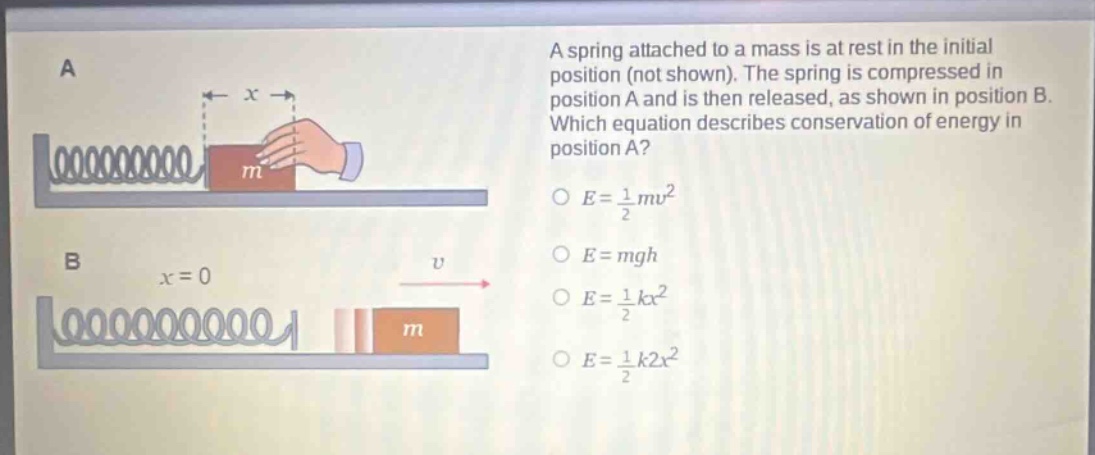
a spring attached to a mass is at rest in the initial position (not shown). the spring is compressed in position a and is then released, as shown in position b. which equation describes conservation of energy in position a?\n$e = \\frac{1}{2}mv^{2}$\n$e = mgh$\n$e = \\frac{1}{2}kx^{2}$\n$e = \\frac{1}{2}k2x^{2}$
Answer
Answer:
C. $E = \frac{1}{2}kx^{2}$
Explanation:
Step1: Identify energy in position A
In position A, the mass - spring system has only elastic potential energy as the mass is at rest ($v = 0$) and there is no height change (so no gravitational potential energy).
Step2: Recall elastic - potential energy formula
The elastic potential energy of a spring is given by $E_p=\frac{1}{2}kx^{2}$, where $k$ is the spring - constant and $x$ is the displacement from the equilibrium position. Here, the spring is compressed by a distance $x$, so the total energy $E$ in position A is the elastic potential energy $E=\frac{1}{2}kx^{2}$.