which statement can best be concluded from the ideal gas law?\no the product of pressure and volume of an…
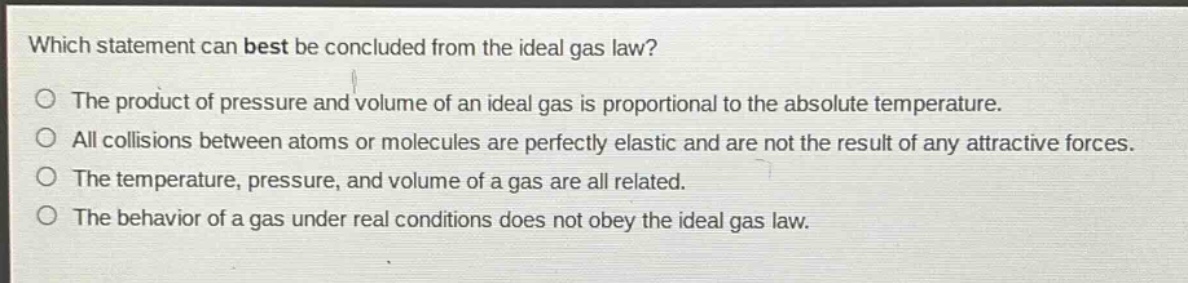
which statement can best be concluded from the ideal gas law?\no the product of pressure and volume of an ideal gas is proportional to the absolute temperature.\no all collisions between atoms or molecules are perfectly elastic and are not the result of any attractive forces.\no the temperature, pressure, and volume of a gas are all related.\no the behavior of a gas under real conditions does not obey the ideal gas law.
Answer
Answer:
The product of pressure and volume of an ideal gas is proportional to the absolute temperature.
Explanation:
Step1: Write the ideal gas law formula
$$PV = nRT$$ where (P) is pressure, (V) is volume, (n) is the amount of substance, (R) is the ideal gas constant, and (T) is the absolute temperature.
Step2: Analyze the proportionality
From (PV = nRT), when (n) and (R) are constant (for a given amount of gas), we can write (PV\propto T). This shows that the product of pressure and volume of an ideal gas is proportional to the absolute temperature.
The second option is a property of ideal gases (molecular behavior) not directly from the ideal gas law formula. The third option is too vague compared to the first option which is a direct mathematical relation from (PV = nRT). The fourth option is a fact about real gases but not the best conclusion from the ideal gas law itself (the ideal gas law is for ideal gases, and this statement is more about deviation of real gases rather than a conclusion from the law's formula).