which statement describes the relationship of voltage and current?\no voltage is directly proportional to…
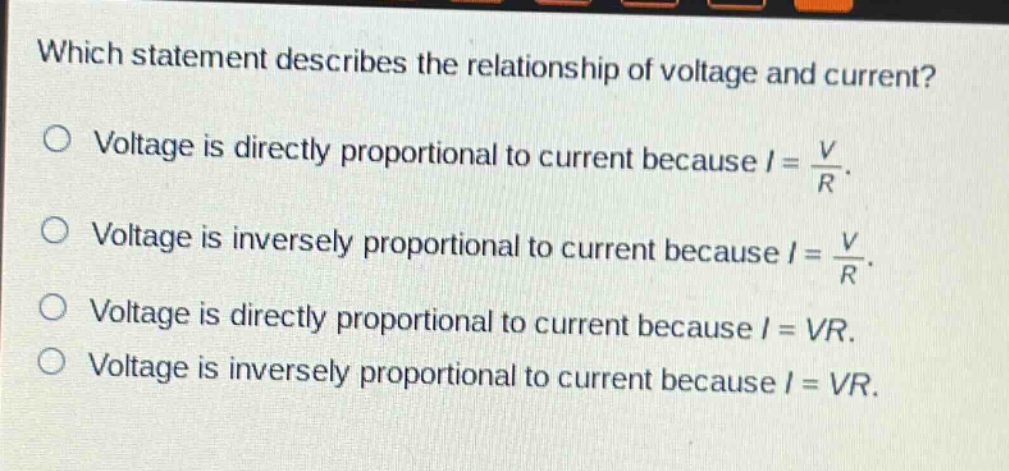
which statement describes the relationship of voltage and current?\no voltage is directly proportional to current because (i = \frac{v}{r}).\no voltage is inversely proportional to current because (i = \frac{v}{r}).\no voltage is directly proportional to current because (i = vr).\no voltage is inversely proportional to current because (i = vr).
Answer
Explanation:
Step1: Recall Ohm's Law
Ohm's Law is given by $I=\frac{V}{R}$, where $I$ is current, $V$ is voltage and $R$ is resistance.
Step2: Analyze proportionality
Rearranging Ohm's Law for $V$ gives $V = IR$. When resistance $R$ is constant, if $I$ increases, $V$ increases and if $I$ decreases, $V$ decreases. So voltage $V$ is directly proportional to current $I$.
Answer:
Voltage is directly proportional to current because $I=\frac{V}{R}$.