which statement explains how planets move in orbit as supported by newtons first law of motion?\nplanets can…
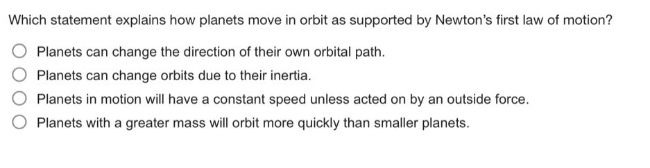
which statement explains how planets move in orbit as supported by newtons first law of motion?\nplanets can change the direction of their own orbital path.\nplanets can change orbits due to their inertia.\nplanets in motion will have a constant speed unless acted on by an outside force.\nplanets with a greater mass will orbit more quickly than smaller planets.
Answer
Brief Explanations:
Newton's first - law of motion states that an object in motion will stay in motion with a constant velocity (constant speed in a straight - line path) unless acted upon by an external force. Planets in orbit follow this law and will have a constant speed unless an outside force (like gravitational interactions with other celestial bodies) acts on them. The first option is incorrect as planets don't change the direction of their orbital path on their own without an outside force. The second option is wrong because inertia is a property of matter that resists changes in motion, not a cause for changing orbits. The fourth option is related to Newton's law of universal gravitation and orbital speed based on mass, not the first law of motion.
Answer:
Planets in motion will have a constant speed unless acted on by an outside force.