which statement would be the most useful for deriving the ideal gas law?\no volume is directly proportional…
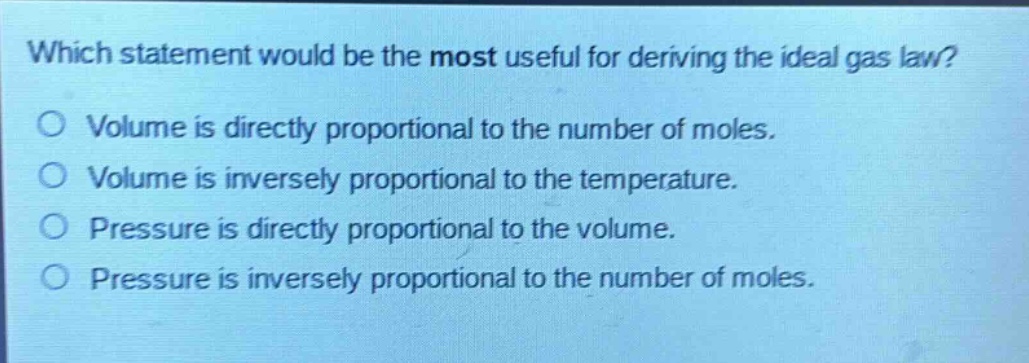
which statement would be the most useful for deriving the ideal gas law?\no volume is directly proportional to the number of moles.\no volume is inversely proportional to the temperature.\no pressure is directly proportional to the volume.\no pressure is inversely proportional to the number of moles.
Answer
Explanation:
Step1: Recall ideal gas law
The ideal - gas law is $PV = nRT$, where $P$ is pressure, $V$ is volume, $n$ is the number of moles, $T$ is temperature and $R$ is the ideal gas constant.
Step2: Analyze proportionality relationships
From $PV=nRT$, we can express $V=\frac{nRT}{P}$. When $P$ and $T$ are constant, $V\propto n$ (volume is directly proportional to the number of moles). Also, $P=\frac{nRT}{V}$, when $n$ and $T$ are constant, $P\propto\frac{1}{V}$ (pressure is inversely proportional to volume), and $V=\frac{nR}{P}T$, when $n$ and $P$ are constant, $V\propto T$ (volume is directly proportional to temperature).
Step3: Evaluate each option
- Option 1: Volume is directly proportional to the number of moles ($V\propto n$ when $P$ and $T$ are constant), which is a correct relationship from the ideal - gas law.
- Option 2: Volume is inversely proportional to the temperature is incorrect. According to $PV = nRT$, $V=\frac{nR}{P}T$, volume is directly proportional to temperature when $n$ and $P$ are constant.
- Option 3: Pressure is directly proportional to the volume is incorrect. According to $PV=nRT$, $P=\frac{nRT}{V}$, pressure is inversely proportional to volume when $n$ and $T$ are constant.
- Option 4: Pressure is inversely proportional to the number of moles is incorrect. According to $PV = nRT$, $P=\frac{nRT}{V}$, pressure is directly proportional to the number of moles when $V$ and $T$ are constant.
Answer:
Volume is directly proportional to the number of moles.